Bread calorie comparison
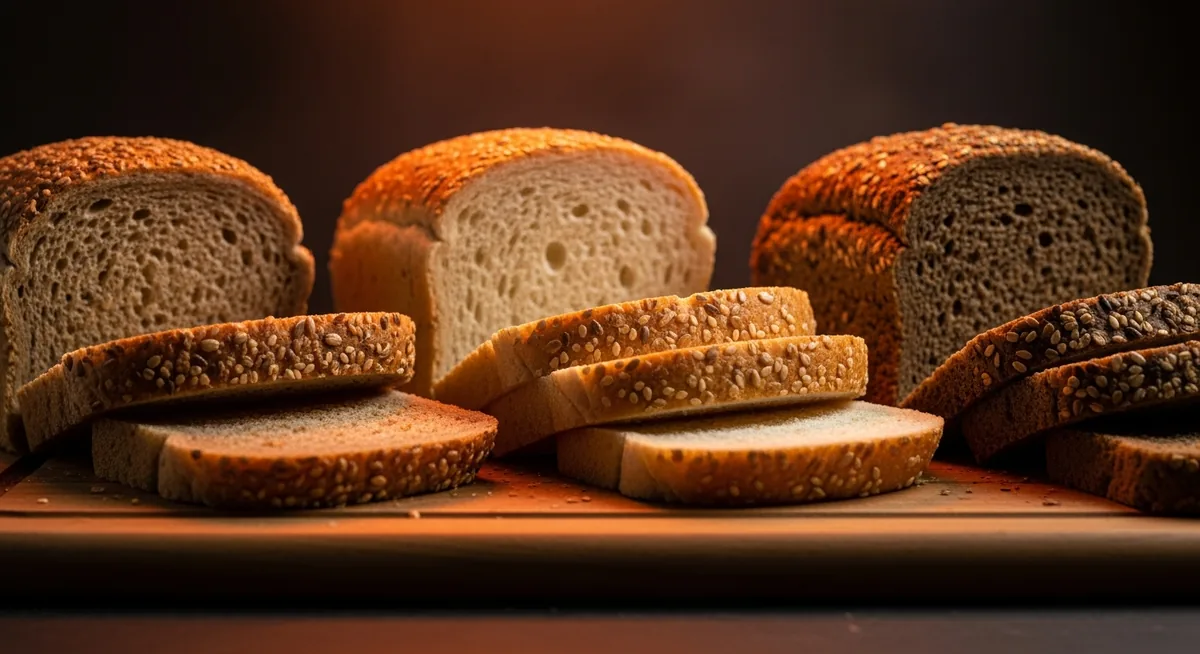
Most bread types land between 220 and 260 kcal per 100 g (3.5 oz). Soft white toast bread reaches up to 280 kcal/100 g thanks to its higher fat and sugar content. Whole-grain bread has the same calorie count as white bread — but far more fiber and micronutrients.
Calories in different bread types
The calorie content of classic breads varies less than most people assume. The deciding factors are water content and ingredients. Pumpernickel — a dense, slow-baked German rye bread — has the highest water content and is therefore lower in calories. Toast bread (soft white sandwich bread) typically contains more fat and sugar than rye bread.
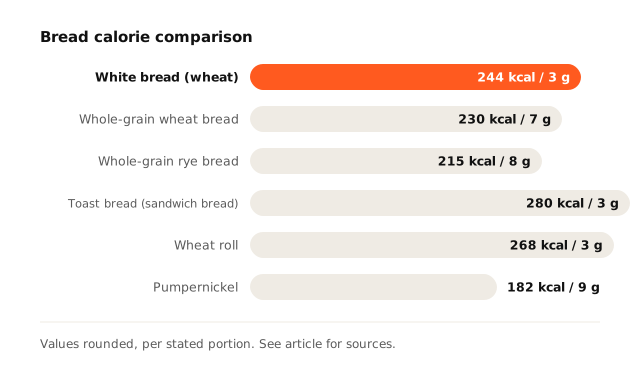
| Type | Calories / fiber per 100 g |
|---|---|
| White bread (wheat) | 244 kcal / 3 g |
| Whole-grain wheat bread | 230 kcal / 7 g |
| Whole-grain rye bread | 215 kcal / 8 g |
| Toast bread (sandwich bread) | 280 kcal / 3 g |
| Wheat roll | 268 kcal / 3 g |
| Pumpernickel | 182 kcal / 9 g |
Nutrient profile compared
Calorie-wise, whole-grain and white bread are almost identical. The difference lies in fiber content and micronutrients. Per the German BLS food database, whole-grain bread delivers more B vitamins, magnesium, and iron per 100 grams. In its 10 dietary rules, the German Nutrition Society (DGE) recommends choosing the whole-grain option for cereal products.
Glycemic index compared
The glycemic index (GI) describes how strongly a carbohydrate-containing food raises blood sugar compared to glucose. The international GI tables by Atkinson et al. (2021) list white bread at around 75, whole-grain bread at around 70, and pumpernickel at around 50.
Bread as a breakfast calorie trap
A typical breakfast roll with butter (10 g), jam (20 g), and cheese (25 g) comes to 400 to 450 calories — close to a full main meal. For a balanced diet, the DGE recommends switching to whole-grain bread and portioning toppings deliberately.
Start tracking calories with GymLog AI
GymLog AI knows all the common bread types and works with realistic slice and roll weights.
Download on the App StoreSources
- Bundeslebensmittelschlüssel (BLS) — Germany’s national food composition database. Max Rubner Institute. blsdb.de
- Atkinson, F. S., et al. (2021). International Tables of Glycemic Index and Glycemic Load Values 2021. Am J Clin Nutr. PubMed
- German Nutrition Society (DGE). The 10 DGE rules — whole-grain products. dge.de