How many carbs do I need per day?

According to the International Society of Sports Nutrition, active people need 3 to 7 grams of carbohydrate per kilogram of body weight. For healthy adults who don't train, the German Nutrition Society (DGE) recommends roughly 45 to 55 percent of total energy intake from carbohydrates.
What carbohydrates do in the body
Carbohydrates provide around 4 kilocalories per gram and are stored in the liver and muscles as glycogen. In healthy adults, muscle glycogen stores hold roughly 300 to 500 grams, depending on body weight and training status (Jentjens & Jeukendrup, 2003). During intense exercise, working muscle draws primarily on these stores.
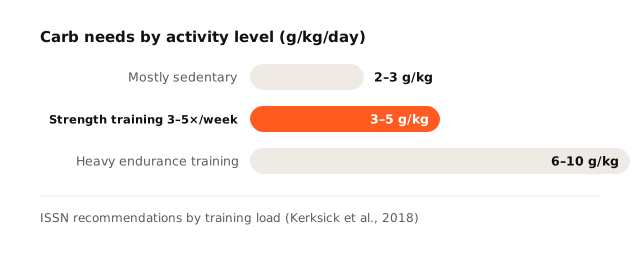
Recommendations by training load
In the updated ISSN nutrition review, Kerksick et al. (2018) differentiate by training volume: 3 to 5 g/kg per day for moderate training loads, 5 to 8 g/kg for high loads, and up to 12 g/kg for very high endurance volumes. For strength athletes without a significant endurance component, the lower to middle range is considered sufficient.
| Activity | Carbs (g/kg/day) |
|---|---|
| Mostly sedentary | 2–3 g/kg |
| Strength training 3–5×/week | 3–5 g/kg |
| Heavy endurance training | 6–10 g/kg |
Quality before quantity
In its reference values, the DGE distinguishes between complex and simple carbohydrates, recommending mostly whole grains, legumes, potatoes, and fiber-rich vegetables. The WHO (2023) recommends a fiber intake of at least 25 grams per day and capping free sugars at under 10 percent of total energy — ideally under 5 percent.
Putting it into practice
Your personal carb amount comes down to three factors: total calorie intake, protein needs, and fat needs. After subtracting protein (about 1.6–2.2 g/kg) and fat (about 0.8–1 g/kg), the remaining calories come from carbohydrates. A 75 kg (165 lb) person on 2,800 kcal a day with 160 g of protein and 75 g of fat ends up at around 300 g of carbs — equivalent to 4 g/kg.
Start tracking calories with GymLog AI
GymLog AI logs your daily carb intake and gives you a clear view of the trend.
Download on the App StoreSources
- Kerksick, C. M., et al. (2018). ISSN exercise & sports nutrition review update: research & recommendations. JISSN, 15:38. jissn.biomedcentral.com
- Jentjens, R., & Jeukendrup, A. E. (2003). Determinants of post-exercise glycogen synthesis during short-term recovery. Sports Medicine, 33(2). PubMed
- German Nutrition Society (DGE). Reference values for carbohydrates. dge.de
- World Health Organization (2023). Carbohydrate intake for adults and children: WHO guideline. who.int
- Sackner-Bernstein, J., et al. (2015). Dietary Intervention for Overweight and Obese Adults: Comparison of Low-Carbohydrate and Low-Fat Diets. PLoS One, 10(10). PubMed