How much fat do I need per day?
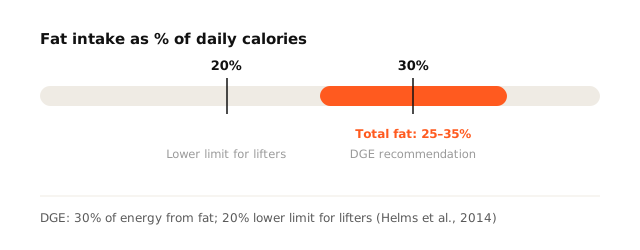
The German Nutrition Society (DGE) recommends getting 30 percent of your daily energy from fat. For active people, that works out to roughly 0.8 to 1.2 grams of fat per kilogram of body weight. Helms et al. (2014) cite a lower limit of 20 percent of total calories as a guideline for strength athletes.
What fat does in the body
Fat provides 9 kilocalories per gram, making it the most energy-dense class of macronutrient. Beyond supplying energy, dietary fat carries the fat-soluble vitamins A, D, E, and K and delivers essential fatty acids the body cannot synthesize on its own — most notably linoleic acid (omega-6) and alpha-linolenic acid (omega-3). The European Food Safety Authority (EFSA, 2010) classifies a minimum intake of these essential fatty acids as nutritionally indispensable.
The evidence on total intake
In their review for strength athletes, Helms et al. (2014) cite a fat intake of at least 20 to 30 percent of total calories as a guideline. The paper bases that lower limit on studies of endocrine and metabolic markers under very low-fat diets; for one of those reference studies, see Volek et al. (1997).
Fat quality
The DGE recommends capping saturated fatty acids at under 10 percent of total energy and increasing the share of unsaturated fats — particularly monounsaturated fats from canola and olive oil, and polyunsaturated fats from flaxseed oil, walnuts, and fatty sea fish. Through its REPLACE initiative in 2018, the WHO set the broad elimination of industrially produced trans fats from the food supply as a goal for member states.
| Type of fat | Recommendation |
|---|---|
| Total fat | 25–35% of calories |
| Saturated fatty acids | < 10% |
| Trans fats (industrial) | as low as possible |
Putting it into practice
A 70 kg (154 lb) person with a daily requirement of 2,500 kcal lands at around 83 grams of fat per day at a 30 percent fat share. Good sources include avocados, nuts, seeds, olive oil, canola oil, fatty sea fish, and eggs. For strength athletes, Helms et al. (2014) recommend not letting fat intake drop below 0.8 g/kg — even on a strict diet.
Start tracking calories with GymLog AI
GymLog AI balances protein, fat, and carbohydrates to match your calorie target.
Download on the App StoreSources
- German Nutrition Society (DGE). Reference values for fat intake. dge.de
- Helms, E. R., et al. (2014). Evidence-based recommendations for natural bodybuilding contest preparation: nutrition and supplementation. JISSN, 11:20. jissn.biomedcentral.com
- Volek, J. S., et al. (1997). Testosterone and cortisol in relationship to dietary nutrients and resistance exercise. J Appl Physiol, 82(1). PubMed
- EFSA (2010). Scientific Opinion on Dietary Reference Values for fats. EFSA Journal, 8(3). efsa.europa.eu
- World Health Organization (2018). REPLACE: an action package to eliminate industrially-produced trans fatty acids. who.int