Omega-3: how much EPA and DHA per day?

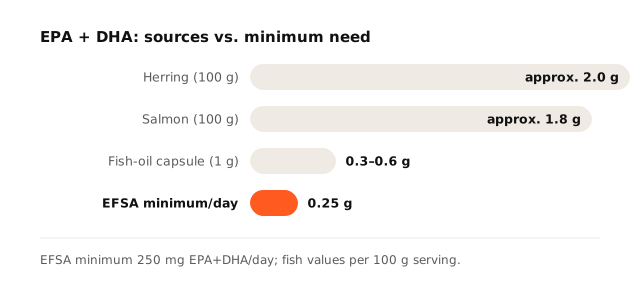
The European Food Safety Authority (EFSA) recommends a daily minimum of 250 mg EPA plus DHA for healthy adults. Oily sea fish, algae oil, and fish-oil capsules are the most common sources.
What omega-3 fatty acids are
Omega-3 fatty acids are polyunsaturated fats that the body can't synthesize in sufficient amounts on its own. The most important forms are eicosapentaenoic acid (EPA) and docosahexaenoic acid (DHA), found mainly in oily sea fish such as salmon, mackerel, and herring, or in algae oil. Alpha-linolenic acid (ALA) from plant sources like flaxseed and walnuts is converted into EPA and DHA only to a small extent (under 10%) (Burdge, 2006).
Official intake recommendations
The European Food Safety Authority (EFSA, 2012) recommends a daily intake of at least 250 mg EPA plus DHA for healthy adults. The German Nutrition Society (DGE) recommends eating one to two servings of sea fish per week, at least one of which should be an oily fish. According to the National Nutrition Survey II (Max Rubner Institute, 2008), a large share of the German population doesn't reach this recommendation through diet alone.
| Source | EPA + DHA per serving |
|---|---|
| 100 g salmon | approx. 1.8 g |
| 100 g herring | approx. 2.0 g |
| 1 fish-oil capsule (1 g) | 0.3–0.6 g (variable) |
Supplementation: options and safety
Fish oil, krill oil, and algae oil (vegan) are the most common supplement forms. The EFSA (2012) considers long-term supplementation of up to 5 g EPA plus DHA per day to be safe. When choosing a supplement, pay attention to the actual EPA/DHA amount per capsule, since the total fish-oil content is not the same as the EPA/DHA content.
Track your supplements with GymLog AI
GymLog AI logs your nutrition and shows your trends over time at a glance.
Download on the App StoreSources
- EFSA (2012). Scientific Opinion on the Tolerable Upper Intake Level of Eicosapentaenoic Acid (EPA), Docosahexaenoic Acid (DHA) and Docosapentaenoic Acid (DPA). EFSA Journal, 10(7), 2815. EFSA
- German Nutrition Society (DGE) (2015). Reference Values — Fat. DGE
- Max Rubner Institute (2008). National Nutrition Survey II — Results Report Part 2. BMEL
- Burdge, G. C. (2006). Metabolism of alpha-linolenic acid in humans. Prostaglandins, Leukotrienes and Essential Fatty Acids, 75(3), 161–168. PubMed