Magnesium: how much per day?

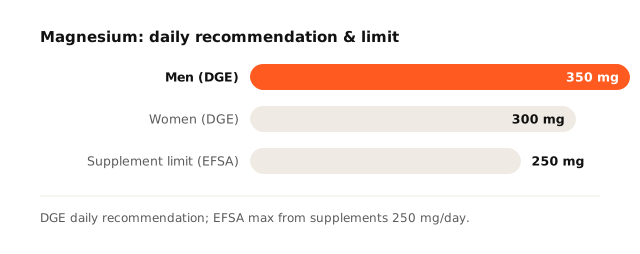
The German Nutrition Society (DGE) recommends 350 mg of magnesium per day for men and 300 mg for women. According to the RKI, around a quarter of adults have a suboptimal supply.
Your daily requirement
The German Nutrition Society (DGE) recommends 350 milligrams of magnesium per day for adult men and 300 milligrams for women. Magnesium is involved in more than 300 enzyme reactions in the body. Around 25 grams of magnesium are stored in the body, mainly in the bones and skeletal muscle (DGE reference values). Good sources include whole-grain products, nuts, legumes, leafy green vegetables, and mineral water.
Supply status in Germany
In the general population, severe magnesium deficiency is considered rare. However, the RKI's DEGS1 study (2013) shows that around a quarter of adults have a suboptimal supply — especially those who eat little vegetables and whole grains. Athletes lose additional magnesium through sweat (Nielsen & Lukaski, 2006).
Supplementation: the safety framework
The European Food Safety Authority (EFSA) recommends taking no more than 250 milligrams of magnesium per day from supplements, on top of a normal diet, to avoid gastrointestinal discomfort. If your diet provides enough, the current evidence suggests no additional supplementation is necessary (Zhang et al., 2017).
| Food | Magnesium per 100 g |
|---|---|
| Pumpkin seeds | approx. 535 mg |
| Almonds | approx. 270 mg |
| Oats | approx. 140 mg |
| Whole-grain bread | approx. 60 mg |
Track your supplements with GymLog AI
GymLog AI logs your nutrition and shows your trends over time at a glance.
Download on the App StoreSources
- German Nutrition Society (DGE). Reference Values for Magnesium. dge.de
- Nielsen, F. H., & Lukaski, H. C. (2006). Update on the relationship between magnesium and exercise. Magnes Res, 19(3). PubMed
- Rude, R. K. (2012). Magnesium. In: Modern Nutrition in Health and Disease. Lippincott Williams & Wilkins.
- Zhang, Y., et al. (2017). Can Magnesium Enhance Exercise Performance? Nutrients, 9(9). PubMed
- Robert Koch Institute (2013). Magnesium supply of adults in Germany — DEGS1. rki.de