How much water should I drink per day?
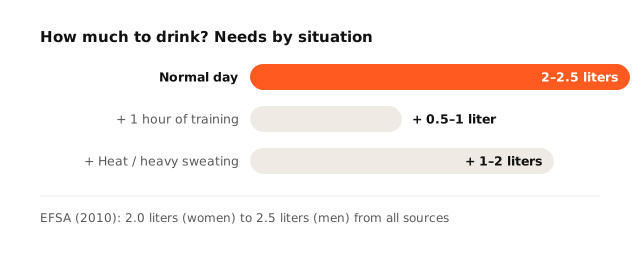
For healthy adults, the EFSA recommends a total fluid intake of 2.0 liters for women and 2.5 liters for men per day from all sources. Strength athletes need an extra 0.5 to 1 liter for every hour of intense training.
The official recommendations
The European Food Safety Authority (EFSA, 2010) recommends a total daily water intake of 2.0 liters for women and 2.5 liters for men. That figure includes fluid from drinks as well as from solid food, which on average accounts for around 20 to 30 percent of total intake. The German Nutrition Society (DGE) works from similar values and recommends at least 1.5 liters (about 6 cups) of plain drinking water per day, ideally spread across your waking hours.
Fluid needs during exercise
During intense physical exertion, the body loses 0.5 to 2 liters of fluid per hour through sweat — depending on ambient temperature, training intensity, and your individual sweat rate. In the American College of Sports Medicine position stand, Sawka et al. (2007) recommend fully replacing water losses within 24 hours of exercise, ideally by drinking 400 to 800 milliliters (14 to 27 fl oz) per hour during longer sessions.
What dehydration does
Cheuvront & Kenefick (2014) show that a fluid deficit of just 2 percent of body weight measurably reduces aerobic capacity and cognitive performance. For strength work the effect is smaller but still documented — particularly at higher ambient temperatures (Judelson et al., 2007).
How to cover your needs in practice
Water, unsweetened tea, heavily diluted fruit juice, and mineral water form the base. Contrary to the old assumption, coffee does not contribute to dehydration (Killer et al., 2014). Sugary and alcoholic drinks do provide fluid, but they shouldn't serve as a primary source because of their calorie density and the effects of alcohol.
| Situation | Recommendation |
|---|---|
| Normal day | 2–2.5 liters |
| 1 hour of training | + 0.5–1 liter |
| Heat / heavy sweating | + 1–2 liters |
Start tracking calories with GymLog AI
GymLog AI reminds you to hit your daily fluid intake and adjusts it on training days.
Download on the App StoreSources
- Judelson, D. A., et al. (2007). Hydration and Muscular Performance: Does Fluid Balance Affect Strength, Power and High-Intensity Endurance? Sports Medicine, 37(10), 907–921. PubMed
- Armstrong, L. E., et al. (1998). Urinary Indices during Dehydration, Exercise, and Rehydration. International Journal of Sport Nutrition, 8(4), 345–355. PubMed
- EFSA (2010). Scientific Opinion on Dietary Reference Values for water. EFSA Journal, 8(3). efsa.europa.eu
- Sawka, M. N., et al. (2007). American College of Sports Medicine position stand. Exercise and fluid replacement. Med Sci Sports Exerc, 39(2). PubMed
- Cheuvront, S. N., & Kenefick, R. W. (2014). Dehydration: physiology, assessment, and performance effects. Compr Physiol, 4(1). PubMed
- Killer, S. C., et al. (2014). No evidence of dehydration with moderate daily coffee intake. PLoS One, 9(1). PubMed
- German Nutrition Society (DGE). Reference values for water. dge.de