How important is sleep for muscle growth?
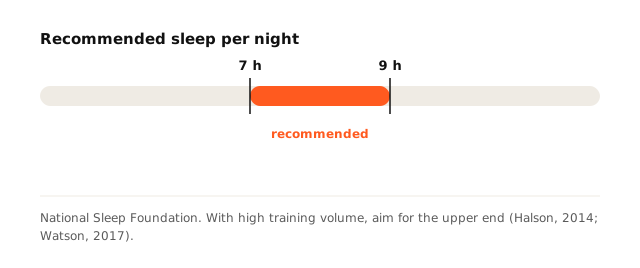
The National Sleep Foundation recommends seven to nine hours of sleep per night for healthy adults. Studies document changes in hormone status and training performance when sleep is chronically restricted below that threshold (Leproult & Van Cauter, 2011; Nedeltcheva et al., 2010).
Hormone status in the research
In a controlled study of young men, Leproult & Van Cauter (2011) describe changes in hormonal markers under sleep restriction compared with the control condition.
Effects on training performance
The literature frequently reports worse outcomes on performance and concentration measures under sleep deprivation (Reilly & Piercy, 1994; Knowles et al., 2018).
Body composition in a calorie deficit
Nedeltcheva et al. (2010) ran a controlled study comparing two groups in a calorie deficit: one sleeping 5.5 hours per night, the other 8.5 hours. Individual studies have shown that sleep deprivation changes the composition of the weight lost. The authors discuss hormone status and nitrogen balance as possible mechanisms.
How much sleep is enough?
The National Sleep Foundation (Hirshkowitz et al., 2015) recommends 7 to 9 hours of sleep per night for healthy adults. For people handling high training volumes, Halson (2014) and Watson (2017) lean toward the upper end of that range. Controlled intervention studies with extended sleep (so-called sleep extension) document measurable performance improvements in athletes.
| Sleep duration | Study findings |
|---|---|
| < 6 hours | Documented changes in hormone status and body composition |
| 7–9 hours | National Sleep Foundation recommendation for adults |
| > 9 hours | No additional benefit established in the literature |
Log your workouts in 5 seconds with GymLog AI
GymLog AI keeps your training and nutrition in one place and gives you a clear view of your progress over time.
Download on the App StoreSources
- Reilly, T. & Piercy, M. (1994). The Effect of Partial Sleep Deprivation on Weight-Lifting Performance. Ergonomics, 37(1), 107–115. PubMed
- Halson, S. L. (2014). Sleep in Elite Athletes and Nutritional Interventions to Enhance Sleep. Sports Medicine, 44(Suppl 1), S13–S23. PubMed
- Leproult, R., & Van Cauter, E. (2011). Effect of 1 week of sleep restriction on testosterone levels in young healthy men. JAMA, 305(21). PubMed
- Nedeltcheva, A. V., et al. (2010). Insufficient sleep undermines dietary efforts to reduce adiposity. Ann Intern Med, 153(7). PubMed
- Knowles, O. E., et al. (2018). Inadequate sleep and muscle strength: Implications for resistance training. J Sci Med Sport, 21(9). PubMed
- Hirshkowitz, M., et al. (2015). National Sleep Foundation’s sleep time duration recommendations. Sleep Health, 1(1). PubMed
- Watson, A. M. (2017). Sleep and Athletic Performance. Curr Sports Med Rep, 16(6). PubMed