How long does it take to build muscle?

The first measurable gains in lean mass show up after 6 to 8 weeks of structured training. How fast you build muscle beyond that depends heavily on training experience, nutrition, genetics, and your starting point.
The first few weeks
During the first 4 to 6 weeks of a new training program, strength gains come mostly from neural adaptations — your nervous system gets better at recruiting motor units and coordinating muscles. An early review by Sale (1988) showed that these neural adaptations account for the bulk of initial strength progress. Actual increases in muscle size (hypertrophy) typically become detectable via ultrasound or MRI from week 6 to 8 onward (DeFreitas et al., 2011).
Realistic timelines
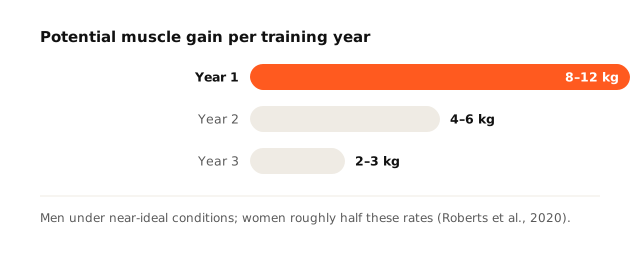
A meta-analysis by Wernbom, Augustsson and Thomée (2007) examined hypertrophy rates across controlled studies and found that untrained lifters gained 0.1 to 0.5% in muscle cross-sectional area per training day. For practical planning, Lyle McDonald's widely cited model — built on the available study data — describes how the rate of growth slows as training experience accumulates:
| Training year | Potential muscle gain/year |
|---|---|
| Year 1 | 8–12 kg (18–26 lb) |
| Year 2 | 4–6 kg (9–13 lb) |
| Year 3 | 2–3 kg (4–7 lb) |
These numbers assume male lifters training under near-ideal conditions: a calorie surplus, enough protein, progressive training, and good sleep. Because of lower testosterone levels, women typically build muscle at roughly half these rates (Roberts et al., 2020).
What determines your rate of growth
In their meta-analysis, Morton et al. (2018) identified the main drivers of hypertrophy: training volume, protein intake (≥ 1.6 g per kg of body weight), and progressive overload. Genetics matter too — in a study of 585 participants, Hubal et al. (2005) found that responses to the exact same training program ranged from a 2% loss to a 59% increase in muscle cross-sectional area.
Log your workouts in 5 seconds with GymLog AI
GymLog AI tracks training volume, weights, and total protein over time — all in one place.
Download on the App StoreSources
- Sale, D. G. (1988). Neural Adaptation to Resistance Training. Medicine & Science in Sports & Exercise, 20(5 Suppl), S135–S145. PubMed
- DeFreitas, J. M., et al. (2011). An Examination of the Time Course of Training-Induced Skeletal Muscle Hypertrophy. European Journal of Applied Physiology, 111(11), 2785–2790. PubMed
- Wernbom, M., Augustsson, J. & Thomée, R. (2007). The Influence of Frequency, Intensity, Volume and Mode of Strength Training on Whole Muscle Cross-Sectional Area in Humans. Sports Medicine, 37(3), 225–264. PubMed
- Hubal, M. J., et al. (2005). Variability in Muscle Size and Strength Gain After Unilateral Resistance Training. Medicine & Science in Sports & Exercise, 37(6), 964–972. PubMed
- Morton, R. W., et al. (2018). A Systematic Review, Meta-Analysis and Meta-Regression of the Effect of Protein Supplementation on Resistance Training-Induced Gains in Muscle Mass and Strength. British Journal of Sports Medicine, 52(6), 376–384. PubMed