How often should you train per week?

For muscle growth, current research supports training each muscle group at least twice per week. Higher total volume can be spread across more sessions.
What the research says
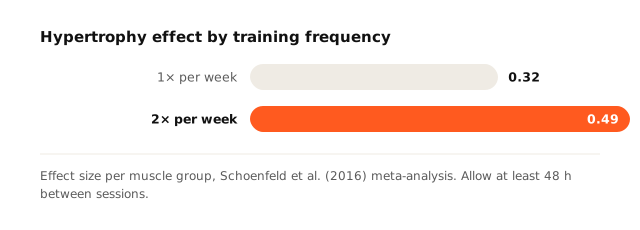
A meta-analysis by Schoenfeld, Ogborn and Krieger (2016) found that training each muscle group at least twice a week produces significantly more hypertrophy than once-weekly training — an effect size of 0.49 vs. 0.32 in favor of the higher frequency. Interestingly, frequency itself wasn't the magic ingredient: the advantage came from spreading weekly volume across several sessions, which keeps the quality of every set higher.
Grgic et al. (2018) confirmed this in a follow-up systematic review: with weekly volume held constant, higher frequency still had the edge for hypertrophy. For pure strength gains, the difference was less clear-cut.
Recommendations by experience level
The American College of Sports Medicine recommends 2 to 3 full-body sessions per week for beginners, while advanced lifters can handle 4 to 6 sessions using a split routine (ACSM, 2009). As Helms, Morgan and Valdez (2019) put it, the key is that every muscle group gets at least 10 sets per week, spread across a minimum of 2 sessions.
| Experience level | Sessions/week | Suggested split |
|---|---|---|
| Beginner (< 1 year) | 2–3 | Full body |
| Intermediate (1–3 years) | 3–4 | Upper/lower |
| Advanced (> 3 years) | 4–6 | Push/pull/legs or similar |
Recovery sets the upper limit
Your capacity to recover puts an individual ceiling on training frequency. Damas et al. (2015) showed that muscle protein synthesis stays elevated for roughly 24 to 48 hours after a training stimulus in trained lifters. A practical takeaway: give each muscle group at least 48 hours before hitting it hard again. Sleep, nutrition, and everyday stress all influence how quickly you bounce back.
Log your workouts in 5 seconds with GymLog AI
GymLog AI plans your training frequency and shows how often each muscle group gets trained per week.
Download on the App StoreSources
- Schoenfeld, B. J., Ogborn, D. & Krieger, J. W. (2016). Effects of Resistance Training Frequency on Measures of Muscle Hypertrophy: A Systematic Review and Meta-Analysis. Sports Medicine, 46(11), 1689–1697. PubMed
- Grgic, J., et al. (2018). Effect of Resistance Training Frequency on Gains in Muscular Strength: A Systematic Review and Meta-Analysis. Sports Medicine, 48(5), 1207–1220. PubMed
- American College of Sports Medicine (2009). Progression Models in Resistance Training for Healthy Adults. Medicine & Science in Sports & Exercise, 41(3), 687–708. PubMed
- Helms, E. R., Morgan, A. & Valdez, A. (2019). The Muscle and Strength Pyramid: Training. 2nd edition.
- Damas, F., et al. (2015). A Review of Resistance Training-Induced Changes in Skeletal Muscle Protein Synthesis and Their Contribution to Hypertrophy. Sports Medicine, 45(6), 801–807. PubMed