Push Pull Legs: how good is PPL really?
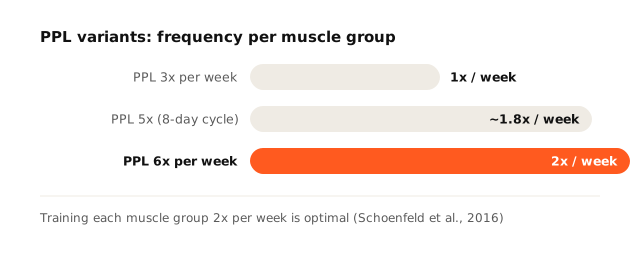
Run at 6 sessions per week, the Push Pull Legs split (PPL) is well supported by research, because every muscle group gets trained twice weekly — in line with the Schoenfeld et al. meta-analysis on optimal training frequency. At only 3 sessions per week, PPL is a suboptimal choice for building muscle.
What Push Pull Legs means
The PPL split groups exercises by movement pattern into three training days:
- Push: pressing movements — chest, front delts, triceps
- Pull: pulling movements — back, rear delts, biceps
- Legs: quads, glutes, hamstrings, calves — often plus abs
PPL and training frequency
The meta-analysis by Schoenfeld et al. (2016) showed that training each muscle group twice per week beats once-weekly training at equal weekly volume. A third weekly session adds no further benefit as long as total volume stays the same (Ralston et al., 2018).
PPL variants compared
| Variant | Frequency per muscle group |
|---|---|
| PPL 3x per week | 1x / week |
| PPL 6x per week | 2x / week |
| PPL 5x on an 8-day cycle | ~1.8x / week |
Who should use PPL?
PPL at 6 sessions per week suits advanced lifters with plenty of time who want to handle high training volume. Because each day covers fewer muscle groups, you can fit enough working sets per muscle without single workouts stretching past two hours. For beginners, the ACSM guidance points the other way — a full-body program at three sessions per week delivers similar or better results in less time.
Strengths and weaknesses
Strengths. Grouping by movement pattern keeps overlap between sessions low and allows focused specialization each day. Your heavy compound lifts always meet fresh muscle groups.
Weaknesses. At low frequency — one session per muscle group per week — PPL falls behind the alternatives in the current data. The rear delts also only get direct work on pull day while the front delts work on push day too; over time that imbalance is worth correcting with face pulls or reverse flys on pull day.
Alternatives to PPL
For three to four training days a week, the research favors an upper/lower split or full-body training as the more efficient choice. With five weekly sessions, a hybrid of upper/lower plus a dedicated weak-point day can work well.
Plan your split with GymLog AI
GymLog AI tracks how often each muscle group gets trained and helps you hit twice-weekly frequency.
Download on the App StoreSources
- Schoenfeld, B. J., et al. (2016). Effects of Resistance Training Frequency on Measures of Muscle Hypertrophy. Sports Medicine. PubMed
- Ralston, G. W., et al. (2018). Weekly Training Frequency Effects on Strength Gain: A Meta-Analysis. Sports Medicine Open. PubMed
- Schoenfeld, B. J., et al. (2019). How many times per week should a muscle be trained to maximize muscle hypertrophy? A systematic review and meta-analysis. JSS. PubMed
- American College of Sports Medicine. ACSM Position Stand: Progression Models in Resistance Training for Healthy Adults. acsm.org
- Baz-Valle, E., et al. (2022). A Systematic Review of The Effects of Different Resistance Training Volumes on Muscle Hypertrophy. Journal of Human Kinetics. PubMed