What is glycogen?

Glycogen is the storage form of carbohydrate in your body. It is stored in muscle cells and the liver and serves as the primary fuel for intense muscular work. An adult stores roughly 400 to 500 grams of glycogen, most of it in skeletal muscle.
Structure and storage sites
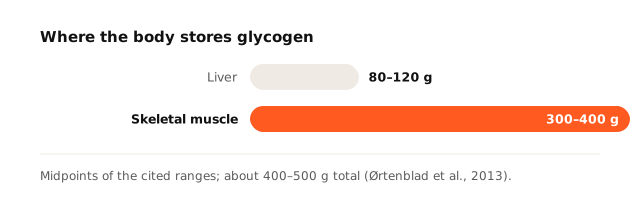
Glycogen is a branched polymer made of glucose molecules. It is stored in two places: the liver holds about 80 to 120 grams, and skeletal muscle holds about 300 to 400 grams (Ørtenblad et al., 2013). Liver glycogen regulates blood sugar levels, while muscle glycogen is available exclusively to the muscle cell it's stored in as a fuel source.
Its role in strength training
During high-intensity exercise, muscle cells rely primarily on muscle glycogen. Anaerobic glycolysis breaks down glucose from glycogen into lactate, releasing energy in the process. Depleted muscle glycogen measurably impairs performance across repeated high-intensity sets (Hearris et al., 2018).
Refilling your stores after training
How quickly glycogen stores refill depends on how much carbohydrate you eat, when you eat it, and how depleted the stores are (Jeukendrup, 2014). With adequate carbohydrate intake, stores are typically fully replenished within 24 hours.
Keep track of your carbs with GymLog AI
GymLog AI logs your daily carbohydrate intake and shows your trend at a glance.
Download on the App StoreSources
- Ørtenblad, N., Westerblad, H., Nielsen, J. (2013). Muscle glycogen stores and fatigue. Journal of Physiology, 591(18). PubMed
- Jeukendrup, A. E. (2014). A step towards personalized sports nutrition: carbohydrate intake during exercise. Sports Medicine, 44(Suppl 1). PubMed
- Hearris, M. A., Hammond, K. M., Fell, J. M., Morton, J. P. (2018). Regulation of Muscle Glycogen Metabolism during Exercise. Nutrients, 10(3). PubMed