How does muscle growth work?

Muscle growth is the increase in muscle mass that results from the interplay of strength training, adequate protein intake, and recovery. At the cellular level, this process is called hypertrophy — the enlargement of existing muscle fibers.
The three pillars of muscle growth
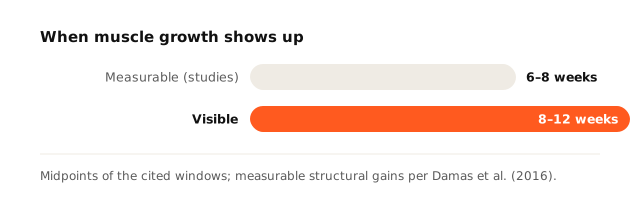
Three conditions are considered essential: a regular training stimulus with sufficient resistance, a protein intake within the recommended range, and enough recovery between sessions. If any one of these pillars is missing, gains drop off sharply. In healthy adults, muscle growth typically becomes measurable after a few weeks of consistent strength training.
Training as the trigger
A muscle only grows when it is challenged beyond what it is used to. The principle behind this is progressive overload — the gradual increase of weight, reps, or sets over time. Programs that stagnate eventually lead to a plateau (Ratamess et al., 2009).
Nutrition as the building material
A protein intake of roughly 1.6 grams per kilogram of body weight per day is frequently cited as a sensible benchmark for strength training (see Morton et al., 2018). On top of that, the body needs energy. A slight calorie surplus supports growth, though it isn't strictly necessary for untrained beginners.
Recovery as the prerequisite
The actual building of new muscle protein happens not during training, but afterward. Sufficient sleep and adequate spacing between sessions for the same muscle group are central to that process. With weekly volume held constant, training each muscle group two to three times per week delivers results comparable to less frequent sessions (Schoenfeld et al., 2016).
Log your workouts in 5 seconds with GymLog AI
GymLog AI tracks your training, protein intake, and body-weight trend in one place.
Download on the App StoreSources
- Morton, R. W., et al. (2018). A systematic review, meta-analysis and meta-regression of the effect of protein supplementation on resistance training-induced gains in muscle mass and strength in healthy adults. British Journal of Sports Medicine, 52(6). PubMed
- Schoenfeld, B. J., Ogborn, D., Krieger, J. W. (2016). Effects of Resistance Training Frequency on Measures of Muscle Hypertrophy: A Systematic Review and Meta-Analysis. Sports Medicine, 46(11). PubMed
- Ratamess, N. A., et al. (2009). Progression Models in Resistance Training for Healthy Adults (ACSM Position Stand). Medicine & Science in Sports & Exercise, 41(3). PubMed
- Damas, F., et al. (2016). The development of skeletal muscle hypertrophy through resistance training. Sports Medicine, 48(4). PubMed