How many reps to build muscle?

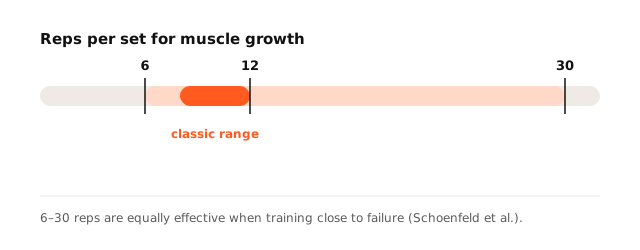
According to the latest meta-analysis by Schoenfeld et al., anywhere from 6 to 30 reps per set builds muscle equally well — provided you train close to muscular failure. The classic recommendation of 8 to 12 reps remains the most practical choice for most lifters.
The repetition continuum
For decades, 6 to 12 reps was treated as the “hypertrophy zone.” The meta-analysis by Schoenfeld et al. (2017) fundamentally challenged that view. Across 21 controlled studies, hypertrophy turned out to be achievable over a much wider spectrum of loads — as long as sets are taken close to muscular failure. Maximal strength gains, by contrast, remain tied to heavier loads with lower rep counts.
Rep ranges by training goal
| Goal | Reps |
|---|---|
| Maximal strength | 1–5 |
| Hypertrophy (classic) | 6–12 |
| Hypertrophy (broad) | 6–30 |
| Strength endurance | 15–30 |
Why the range is so wide
Based on current research, the central mechanism behind muscle growth is the mechanical tension generated within individual muscle fibers (Schoenfeld, 2010). That tension develops both under heavy loads with few reps and under lighter loads with many reps, once the fast-twitch fibers have to be recruited toward the end of the set. What matters is that the final reps feel genuinely hard — Grgic et al. (2022) put the practical threshold at an RIR (reps in reserve) of 0 to 3.
Combining different rep ranges
A study by Schoenfeld et al. (2014) compared a pure hypertrophy protocol (10–12 reps) with a combined approach of heavy sets (2–4 reps), moderate sets (8–10), and high-rep sets (20–30). Both groups built a comparable amount of muscle, but the combination group gained more maximal strength. The practical takeaway: heavy compound lifts in the 4–6 rep range and isolation exercises in the 10–15 rep range complement each other well.
Where the continuum ends
Above 35–40 reps per set, aerobic metabolism takes over. In that range, factors other than mechanical tension dominate, and the hypertrophy effect declines according to current data (Lopez et al., 2021). Below 3 reps, the muscle-building effect remains, but the training volume per unit of time is so low that you'd need an impractical number of working sets to give the muscle a sufficient growth stimulus.
Log your workouts in 5 seconds with GymLog AI
GymLog AI logs reps, weight, and RIR for every set automatically and shows your progress per exercise.
Download on the App StoreSources
- Schoenfeld, B. J., et al. (2017). Strength and Hypertrophy Adaptations Between Low- vs. High-Load Resistance Training: A Systematic Review and Meta-Analysis. JSCR. PubMed
- Schoenfeld, B. J. (2010). The mechanisms of muscle hypertrophy and their application to resistance training. JSCR. PubMed
- Schoenfeld, B. J., et al. (2014). Effects of different volume-equated resistance training loading strategies on muscular adaptations in well-trained men. JSCR. PubMed
- Grgic, J., et al. (2022). Effects of resistance training performed to repetition failure or non-failure on muscular strength and hypertrophy: A systematic review and meta-analysis. J Sport Health Sci. PubMed
- Lopez, P., et al. (2021). Resistance Training Load Effects on Muscle Hypertrophy and Strength Gain: Systematic Review and Network Meta-analysis. Med Sci Sports Exerc. PubMed
- American College of Sports Medicine. ACSM Position Stand: Progression Models in Resistance Training. acsm.org