How long should you rest between sets?

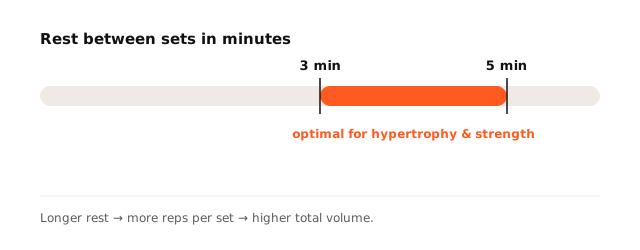
For hypertrophy and strength, rest periods of three to five minutes beat shorter breaks. The extra recovery lets you complete more reps per set — and that means more total volume.
The old consensus — and why it's outdated
For a long time, the standard advice for hypertrophy was to rest just 30 to 90 seconds between sets to maximize metabolic stress. The idea rested on the assumption that short rest periods amplify the hormonal response and thereby promote muscle growth. Current research has put that approach into perspective.
What the current evidence shows
Schoenfeld et al. (2016) ran a controlled study comparing two groups on an identical training program with different rest periods: one minute versus three minutes. After eight weeks, the longer-rest group showed significantly greater gains in muscle thickness and maximal strength. Grgic et al. (2017) confirmed the finding in a meta-analysis of eight studies: longer rest periods (≥ 2 minutes) beat shorter ones (≤ 1 minute) for both hypertrophy and strength.
Why longer rest works better
The primary explanation is higher performance density: with enough recovery between sets, you can complete more reps with heavier weight. The resulting higher total volume is, according to current research, the dominant driver of muscle growth. The hormonal response — short-term spikes in testosterone and growth hormone — is no longer considered causally relevant for hypertrophy (Schoenfeld, 2013).
Recommendations by exercise and goal
| Exercise type | Recommended rest |
|---|---|
| Big compound lift (squat, deadlift) | 3–5 minutes |
| Multi-joint exercise (bench press, rows) | 2–3 minutes |
| Isolation exercise (biceps curl, lateral raise) | 60–120 seconds |
Putting it into practice
If your training time is limited, supersets pairing antagonistic muscle groups (e.g. bench press and rows) boost time efficiency without sacrificing performance density per set. Rest periods under 60 seconds should be reserved for dedicated endurance work or isolation exercises.
Log your workouts in 5 seconds with GymLog AI
GymLog AI tracks your rest periods automatically and flags deviations from your plan.
Download on the App StoreSources
- Schoenfeld, B. J., et al. (2016). Longer interset rest periods enhance muscle strength and hypertrophy in resistance-trained men. J Strength Cond Res, 30(7). PubMed
- Grgic, J., et al. (2017). The Effects of Short Versus Long Inter-Set Rest Intervals in Resistance Training on Measures of Muscle Hypertrophy: A Systematic Review. Eur J Sport Sci, 17(8). PubMed
- Schoenfeld, B. J. (2013). Postexercise hypertrophic adaptations: a reexamination of the hormone hypothesis. J Strength Cond Res, 27(6). PubMed