How many warm-up sets do you need?
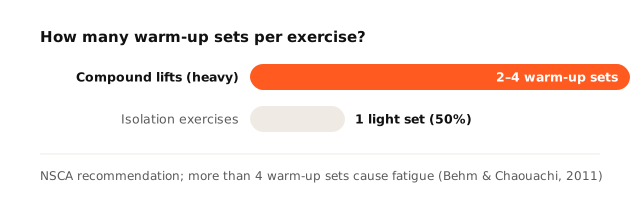
For heavier compound lifts, the NSCA recommends 2 to 4 warm-up sets that approach your working weight in steps of 20 to 30 percent. For isolation exercises, a single light warm-up set at 50 percent of your working weight is usually enough.
Why warming up matters
Warm-up sets aren't just about avoiding injury — they prepare you to perform. A meta-analysis by Fradkin et al. (2010) in the BJSM showed that a specific warm-up improves strength performance by 6 to 8 percent on average. The effects come from higher muscle temperature, faster nerve conduction, and active neural priming of the movement.
A proven ramp-up scheme
| Percent of working weight | Reps |
|---|---|
| 40% (empty bar or very light) | 8–10 |
| 60% | 5–6 |
| 80% | 2–3 |
| 90% | 1 |
It depends on the exercise
How many warm-up sets you need depends heavily on the exercise and the absolute load. Per NSCA recommendations, squatting a working weight of 140 kg (310 lb) calls for more warm-up sets than curling 15 kg (33 lb), because the muscle-tendon loading and the technical complexity are far higher. A typical scheme for squats or bench press in advanced lifters runs three to five warm-up sets, while a single set is often enough on the leg press or lat pulldown.
Scale back after the first exercise
Once you've already trained an exercise for the same muscle group, the follow-up exercises need fewer warm-up sets — often just one set at 60 to 70 percent of your working weight. The muscle is already perfused and the neural pathways are primed. Moving from squats to the leg press, that shortcut saves five to ten minutes per session.
Too much warming up backfires
A review by Behm and Chaouachi (2011) shows that an overly long or overly intense warm-up can hurt performance in your working sets. According to the data, more than four warm-up sets cause measurable peripheral fatigue and lower the rep count in your first working set. A warm-up should prepare your body for the load — not wear it out.
Log your workouts in 5 seconds with GymLog AI
GymLog AI tracks warm-up and working sets separately and only counts the sets that matter toward your weekly volume.
Download on the App StoreSources
- Fradkin, A. J., et al. (2010). Effects of warming-up on physical performance: a systematic review with meta-analysis. BJSM. PubMed
- McGowan, C. J., et al. (2015). Warm-Up Strategies for Sport and Exercise: Mechanisms and Applications. Sports Medicine. PubMed
- Behm, D. G., Chaouachi, A. (2011). A review of the acute effects of static and dynamic stretching on performance. Eur J Appl Physiol. PubMed
- NSCA. Essentials of Strength Training and Conditioning, 4th Edition. nsca.com