What is maximal strength?
Maximal strength is the highest force a muscle can produce voluntarily in a single repetition. In practice it is measured via the 1-repetition maximum (1RM). For dedicated maximal strength work, the ACSM recommends intensities of 85% of 1RM or more.
Definition and measurement
In sports science, maximal strength refers to the highest force the neuromuscular system can voluntarily produce in a single maximal contraction. The standard measure is the 1-repetition maximum (1RM) — the heaviest weight you can move through an exercise exactly once with proper technique.
How it differs from hypertrophy and strength endurance
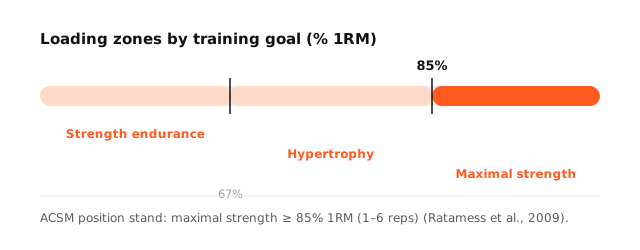
The American College of Sports Medicine's position stand distinguishes three primary training goals, each with its own loading zone: maximal strength (≥ 85% of 1RM, 1–6 reps), hypertrophy (67–85% of 1RM, 6–12 reps), and strength endurance (≤ 67% of 1RM, ≥ 15 reps) (Ratamess et al., 2009). The boundaries are fluid — moderate loads can also drive maximal strength gains when executed appropriately.
What determines maximal strength
Maximal strength is shaped by both neural adaptations (intramuscular coordination, recruitment of high-threshold motor units) and muscular adaptations (increased cross-sectional area, hypertrophy) (Sale, 1988). Neural adaptations dominate during the first weeks of training; structural changes carry more weight later on.
Log your workouts in 5 seconds with GymLog AI
GymLog AI estimates your 1RM automatically from your working sets and shows how it develops over time.
Download on the App StoreSources
- Ratamess, N. A., et al. (2009). Progression Models in Resistance Training for Healthy Adults (ACSM Position Stand). Medicine & Science in Sports & Exercise, 41(3). PubMed
- Sale, D. G. (1988). Neural adaptation to resistance training. Medicine & Science in Sports & Exercise, 20(5 Suppl). PubMed
- Schoenfeld, B. J., Grgic, J., Van Every, D. W., Plotkin, D. L. (2021). Loading Recommendations for Muscle Strength, Hypertrophy, and Local Endurance: A Re-Examination of the Repetition Continuum. Sports, 9(2). PubMed