How heavy should you train?
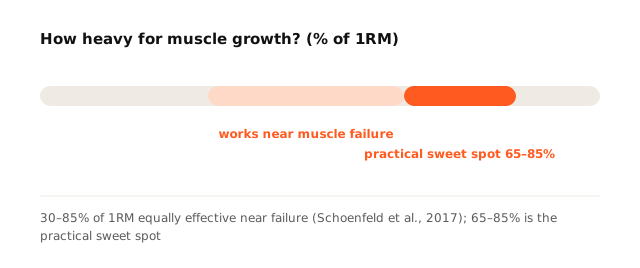
For muscle growth, the meta-analysis by Schoenfeld et al. (2017) shows comparable results across loads of 30 to 85 percent of your one-rep max, as long as sets end close to muscle failure. For maximal strength, the literature describes loads above 80 percent of 1RM.
What does "heavy" mean in training?
The sports-science measure of training intensity is the percentage of your one-rep max — the load you can move for exactly one clean repetition (1RM). Alternatively, subjective scales like RIR (Reps in Reserve) or RPE (Rate of Perceived Exertion) are used. The advantage of RIR: it works without max testing and accounts for day-to-day fluctuations in performance.
Intensity zones and their effects
| Load (% 1RM) | Primary effect |
|---|---|
| 90–100% | Maximal strength |
| 70–85% | Strength & hypertrophy |
| 50–70% | Hypertrophy |
| 30–50% | Hypertrophy (when taken to failure) |
The role of muscle failure
The central finding of the Schoenfeld meta-analysis (2017) was that even light loads of 30 percent of 1RM deliver hypertrophy results comparable to heavy loads, as long as every working set ends close to muscle failure. The reason: toward the end of a set, even with light weight, the powerful fast-twitch muscle fibers have to be recruited to keep the movement going. Grgic et al. (2022) document in a further meta-analysis that an RIR of 0 to 3 per set already produces a hypertrophy effect comparable to sets taken to complete muscle failure.
The problem with low intensities
Although light loads are theoretically equivalent, studies reveal a practical downside: training at 30 percent of 1RM to failure is mentally and systemically more demanding. Morton et al. (2016) report greater perceived exhaustion and longer recovery times after high-volume light-load training. That's why the training literature frequently names the range between 65 and 85 percent of 1RM as the practical sweet spot between training stimulus and time investment.
Intensity and recovery
Heavy loads tax the central nervous system more than moderate loads. For loads above 85 percent of 1RM, the ISSN recommends one session per muscle group per week, or clearly separated heavy and lighter sessions. According to Haff and Triplett (NSCA), working exclusively in the maximal strength zone over the long term raises the risk of overtraining and injury.
Log your workouts in 5 seconds with GymLog AI
GymLog AI suggests the right load for every exercise, based on your RIR and your previous training.
Download on the App StoreSources
- Schoenfeld, B. J., et al. (2017). Strength and Hypertrophy Adaptations Between Low- vs. High-Load Resistance Training: A Systematic Review and Meta-Analysis. JSCR. PubMed
- Grgic, J., et al. (2022). Effects of resistance training performed to repetition failure or non-failure on muscular strength and hypertrophy: Meta-analysis. J Sport Health Sci. PubMed
- Morton, R. W., et al. (2016). Neither load nor systemic hormones determine resistance training-mediated hypertrophy or strength gains in resistance-trained young men. J Appl Physiol. PubMed
- Kerksick, C. M., et al. (2018). ISSN exercise & sports nutrition review update: research & recommendations. JISSN, 15:38. PubMed
- Haff, G. G., Triplett, N. T. (Eds.) (2016). Essentials of Strength Training and Conditioning. National Strength and Conditioning Association. nsca.com
- American College of Sports Medicine. ACSM Position Stand: Progression Models in Resistance Training. acsm.org