What is RIR (Reps in Reserve)?

RIR (Reps in Reserve) is the number of reps you could still perform before reaching muscle failure. It is a well-established method for controlling training intensity with precision.
The scale
A working set taken to RIR 0 ends in complete muscle failure. At RIR 2, you stop the set two reps short of failure. The concept is considered a reliable complement — or alternative — to classic percentage-of-1RM programming (Helms et al., 2016).
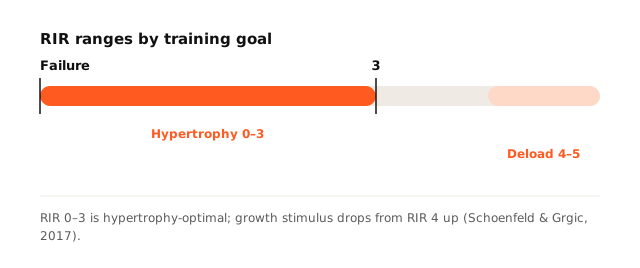
Recommended RIR ranges
| Goal | RIR |
|---|---|
| Hypertrophy (primary range) | 0–3 |
| Strength (heavy compound lifts) | 1–3 |
| Recovery phases / deload | 4–5 |
How accurate are RIR estimates?
Experienced lifters judge their RIR considerably better than beginners do (Hackett et al., 2017). Accuracy improves with training experience and with deliberately reflecting on every set after you finish it.
Log your workouts in 5 seconds with GymLog AI
GymLog AI records RIR for every set and automatically suggests increasing the load when your intensity drops too low.
Download on the App StoreSources
- Helms, E. R., et al. (2016). RPE and Velocity Relationships for the Back Squat, Bench Press, and Deadlift in Powerlifters. J Strength Cond Res, 31(2). PubMed
- Hackett, D. A., et al. (2017). Estimation of repetitions to failure for monitoring resistance exercise intensity. J Strength Cond Res, 31(8). PubMed
- Schoenfeld, B. J., & Grgic, J. (2017). Evidence-based guidelines for resistance training volume to maximize muscle hypertrophy. Strength Cond J, 40(4). PubMed