What is training volume?
Training volume describes the total work done in a strength training program, typically measured as the number of hard sets per muscle group per week. For hypertrophy, gains increase markedly from about 10 sets per muscle group per week upward.
Definition and how it's measured
Training volume can be quantified in several ways. The most common approach is counting hard working sets per muscle group within a training week. Alternatively, volume can be calculated as volume load — the product of reps, sets, and weight. For managing strength training in practice, weekly set count has emerged as the most workable metric.
The dose-response relationship
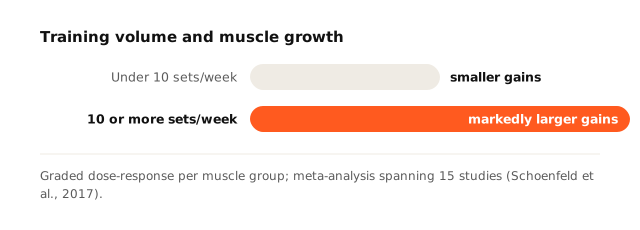
There is a graded dose-response relationship between weekly training volume and muscle growth: fewer than 10 sets per muscle group per week produce smaller gains, while 10 or more sets produce markedly larger ones — the finding of a meta-analysis spanning 15 studies (Schoenfeld et al., 2017). A clear upper limit, beyond which additional volume yields no further benefit, was not conclusively established in that analysis.
Training volume and progressive overload
Volume alone isn't enough. For a training stimulus to keep working over time, it has to be progressively increased — through more weight, more reps, or additional sets. A program that never changes leads to a plateau in the medium to long term (Ratamess et al., 2009).
Log your workouts in 5 seconds with GymLog AI
GymLog AI automatically counts your weekly sets per muscle group and shows when you're in the effective volume range.
Download on the App StoreSources
- Schoenfeld, B. J., Ogborn, D., Krieger, J. W. (2017). Dose-response relationship between weekly resistance training volume and increases in muscle mass: A systematic review and meta-analysis. Journal of Sports Sciences, 35(11). PubMed
- Ratamess, N. A., et al. (2009). Progression Models in Resistance Training for Healthy Adults (ACSM Position Stand). Medicine & Science in Sports & Exercise, 41(3). PubMed
- Krieger, J. W. (2010). Single vs. multiple sets of resistance exercise for muscle hypertrophy: A meta-analysis. Journal of Strength and Conditioning Research, 24(4). PubMed