Should you train to muscle failure?

Training to absolute muscle failure is not strictly necessary for hypertrophy. An RIR of 1 to 3 (Reps in Reserve) delivers comparable results with considerably less neural fatigue.
What muscle failure means
Muscle failure is the point at which another repetition is no longer possible with correct technique despite maximal effort. Absolute failure corresponds to an RIR of zero. Whether training to this point is required for muscle growth has occupied exercise scientists for decades.
The current evidence
Grgic et al. (2021) analyzed 15 studies in a meta-analysis and found no significant difference in hypertrophy gains between training to muscle failure and training with 1 to 3 reps left in the tank. Davies et al. (2017) likewise confirmed in an earlier review that failure offers no clear advantage for strength or muscle gains.
The downsides of training to failure
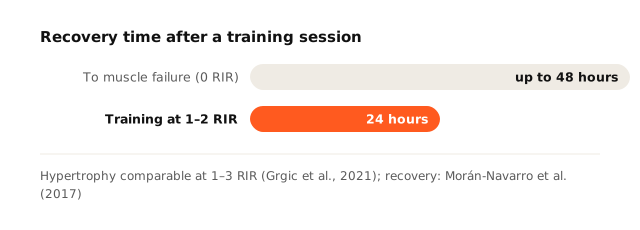
Morán-Navarro et al. (2017) showed that training to muscle failure leads to significantly longer neural and muscular recovery times — up to 48 hours, compared with 24 hours when training with 1–2 RIR. At high weekly volumes with multiple sessions per muscle group, this cuts into your total volume capacity. Failure also raises the injury risk, especially on multi-joint exercises with free weights.
When failure can make sense
On isolation exercises with low injury risk (biceps curls, leg extensions) and in the final session before a planned deload week, failure can be used deliberately. Davies et al. (2017) caution, however, that applying it consistently over longer periods can lead to overtraining.
| Exercise type | Recommended RIR |
|---|---|
| Big compound lifts (squat, deadlift) | 2–3 |
| Multi-joint exercises (bench press, pull-ups) | 1–2 |
| Isolation exercises | 0–1 |
Log your workouts in 5 seconds with GymLog AI
GymLog AI records the RIR of every set and helps you manage intensity and recovery.
Download on the App StoreSources
- Grgic, J., et al. (2021). Resistance training performed to failure or not to failure: A meta-analysis. J Sci Med Sport, 24(4). PubMed
- Davies, T., et al. (2017). Effect of training leading to repetition failure on muscular strength: A systematic review and meta-analysis. Sports Medicine, 46(4). PubMed
- Morán-Navarro, R., et al. (2017). Time course of recovery following resistance training leading or not to failure. Eur J Appl Physiol, 117(12). PubMed