Are drop sets effective?

Drop sets can match the hypertrophy of straight sets in the same amount of time — but they don't beat them. They work best as a time-efficient intensity technique on machines and isolation exercises, not as the foundation of a program.
What is a drop set?
A drop set is an intensity technique: once you hit muscle failure, you reduce the weight and keep going without resting. Two to three weight reductions of 20 to 30 percent each are typical. The goal is to squeeze out additional reps in the target muscle despite mounting fatigue, extending the mechanical loading under higher metabolic stress.
What the studies show
| Parameter | Result vs. straight sets |
|---|---|
| Hypertrophy at matched volume | No significant difference |
| Hypertrophy per unit of time | Tends to be higher |
| Maximal strength | Slightly weaker |
The state of the evidence
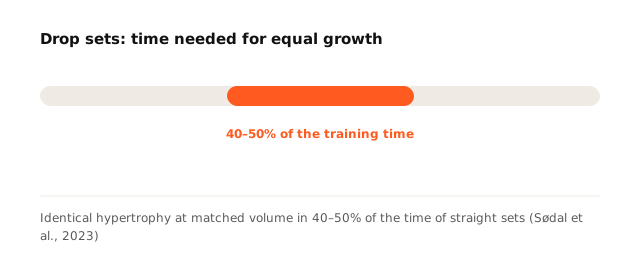
A meta-analysis by Sødal et al. (2023) evaluated 12 controlled studies comparing drop sets with straight sets. The result: at matched total volume, hypertrophy gains are statistically identical. Drop sets achieve the same effect in considerably less time, though — typically 40 to 50 percent of the training duration. For maximal strength, straight sets showed slightly better results, presumably thanks to better recovery between working sets.
Using drop sets sensibly
Per ISSN and JSCR recommendations, drop sets should make up no more than 10 to 15 percent of your weekly training volume. According to Schoenfeld, using them too often raises the risk of central fatigue and compromises recovery between training days. A typical setup: one or two drop sets on the final exercise per muscle group, as a finishing stimulus.
Who benefits most
Drop sets are most interesting for lifters on a tight schedule. If you can only invest 45 to 60 minutes per session, drop sets let you reach a comparable volume in less time. For beginners, the ISSN position stand suggests the technique is less suitable — they get more out of straight sets with clean technique and progressive overload. Advanced lifters with solid exercise execution can deploy drop sets strategically as a plateau breaker.
Log your workouts in 5 seconds with GymLog AI
GymLog AI tracks drop sets and intensity techniques automatically and shows you how they fit into your weekly volume.
Download on the App StoreSources
- Sødal, L. K., et al. (2023). Effects of Drop Sets on Skeletal Muscle Hypertrophy: A Systematic Review and Meta-Analysis. Sports Medicine – Open. PubMed
- Schoenfeld, B. J., Grgic, J. (2019). Does training to failure maximize muscle hypertrophy? Strength and Conditioning Journal. PubMed
- Fink, J., et al. (2018). Effects of drop set resistance training on acute stress indicators and hypertrophy. J Sports Med Phys Fitness. PubMed
- Kerksick, C. M., et al. (2018). ISSN exercise & sports nutrition review update: research & recommendations. JISSN, 15:38. PubMed