Are supersets effective?

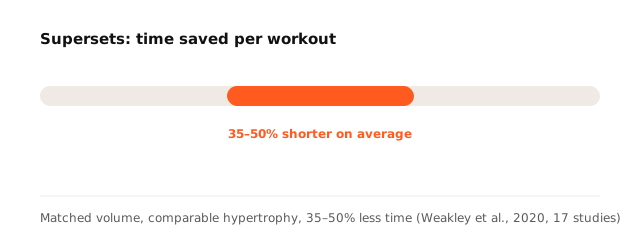
Supersets cut workout time by an average of 35 to 50 percent and, at matched volume, produce muscle growth comparable to straight sets. Maximal strength benefits less, though — for that, long rest periods are clearly superior.
What is a superset?
A superset means performing two exercises back to back with no rest, or only minimal rest, in between. Sports science distinguishes three variants:
- Agonist superset: Two exercises for the same muscle group (e.g. bench press + dumbbell flyes)
- Antagonist superset: Opposing muscles trained back to back (e.g. biceps curls + triceps extensions)
- Non-competing muscle groups: e.g. leg press + rows
What the research says
The systematic review by Weakley et al. (2020) analyzed 17 studies on supersets and comparable techniques. The verdict: at matched training volume (sets × reps × weight), supersets deliver a hypertrophy stimulus comparable to traditional set-rest-set training, while cutting workout duration by 35 to 50 percent on average. Krzysztofik et al. (2019) reached similar conclusions in their review.
How the variants stack up
| Superset type | Suitability |
|---|---|
| Antagonist | Very good |
| Non-competing | Good |
| Agonist | Limited |
The weak spot: heavy compound lifts
The biggest performance losses show up in heavy multi-joint exercises under high loads. Paz-Arellano et al. (2020) found that antagonist supersets pairing the bench press with bent-over rows reduced performance in every single set by 6 to 9 percent. For lifters whose primary goal is maximal strength, classic separated sets with 3 to 5 minutes of rest remain the better choice — which lines up with ACSM recommendations.
Putting it into practice
A recommended session structure when supersets are on the menu:
- Compound lift 1 (heavy): 3–4 sets of 4–6 reps, 2–3 minutes rest
- Compound lift 2 (heavy): 3 sets of 6–8 reps, 2 minutes rest
- Isolation superset 1: 3 × 10–12, antagonist pair
- Isolation superset 2: 3 × 10–12, antagonist pair
This structure protects the quality of your heavy sets and deploys supersets exactly where they deliver the biggest efficiency gain.
Log your workouts in 5 seconds with GymLog AI
GymLog AI groups your supersets automatically and factors in the rest periods — antagonist pairings included.
Download on the App StoreSources
- Weakley, J. J. S., et al. (2020). Supersets Do Not Change Energy Expenditure or Training Volume Compared With Traditional Sets. Scand J Med Sci Sports. PubMed
- Krzysztofik, M., et al. (2019). Maximizing Muscle Hypertrophy: A Systematic Review of Advanced Resistance Training Techniques and Methods. Int J Environ Res Public Health. PubMed
- Paz-Arellano, G., et al. (2020). Acute effects of supersets on upper-body muscle performance. JSCR. PubMed
- Grgic, J., et al. (2017). The Effects of Short Versus Long Inter-Set Rest Intervals in Resistance Training on Measures of Muscle Hypertrophy: A Systematic Review. Eur J Sport Sci. PubMed
- American College of Sports Medicine. ACSM Position Stand: Progression Models in Resistance Training. acsm.org