Crunches vs. planks: which is more effective?
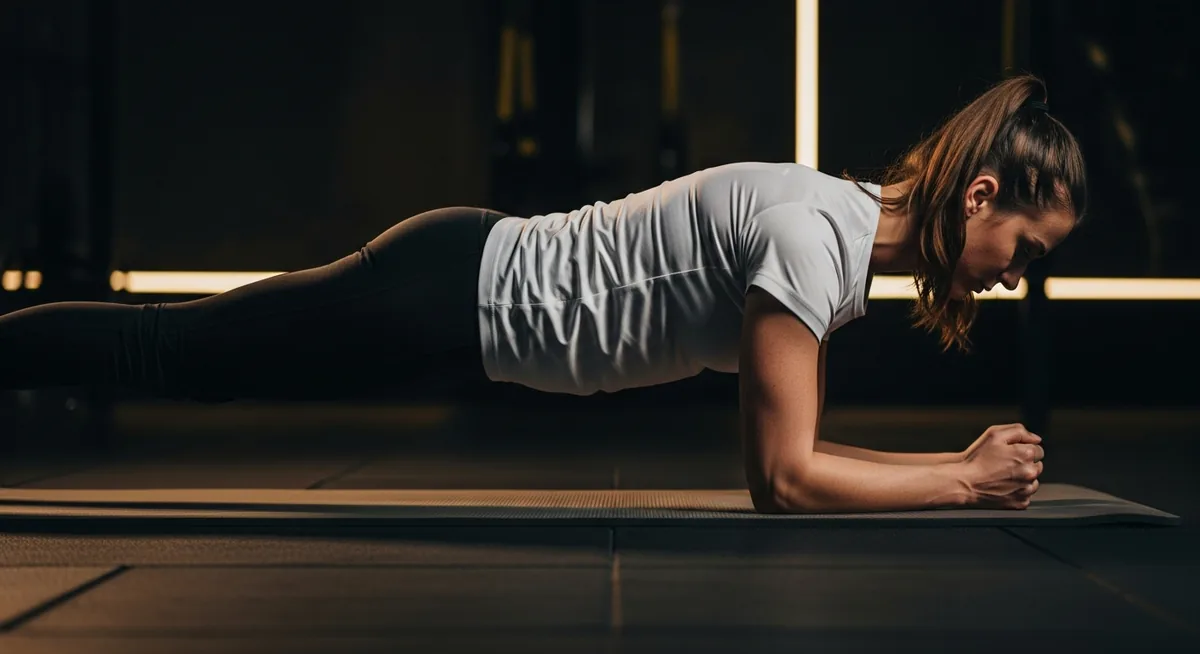
Crunches work the rectus abdominis dynamically through a large contraction range. Planks train the entire core statically and functionally — including the deep stabilizers and the muscles that support your spine. The two exercises complement each other well.
Two different movement principles
Crunches are a dynamic exercise built on spinal flexion: you lift your upper body off the floor, loading the rectus abdominis (the "six-pack muscle") concentrically. Planks are an isometric exercise with no movement at all: you hold your body in a neutral position while the entire core stabilizes your pelvis and spine against gravity.
The evidence on muscle activation
| Exercise | Core muscle activation |
|---|---|
| Crunches | High in the rectus, low in the lateral core |
| Plank (forearm plank) | Even across the entire core |
| Side plank | High in the lateral core + hip abductors |
What the studies show
Escamilla et al. (2010) analyzed the EMG activity of various abdominal exercises. Crunches produced the highest rectus abdominis activation, while planks and side planks additionally recruited the obliques and the transversus abdominis. McGill (2010), in his landmark work on spine health, showed that isometric exercises like planks place less stress on the spine than dynamic flexion exercises — particularly relevant for anyone with existing back problems.
What ab training won't do
Neither crunches nor planks burn belly fat specifically. Spot reduction is considered debunked, per Vispute et al. (2011) — fat loss happens systemically through a calorie deficit. A visible six-pack comes from low body fat (men < 12%, women < 20%), not from isolated ab work.
Practical recommendation
For a complete core routine, McGill recommends combining static and dynamic exercises:
- Plank (forearm plank) — 30 to 60 seconds for core stability
- Side plank — 20 to 40 seconds per side for the lateral core
- Crunches or hanging leg raises — 8 to 15 reps for rectus hypertrophy
- Bird dog — as an extra for the deep back stabilizers
Log your workouts in 5 seconds with GymLog AI
GymLog AI logs both dynamic ab exercises (reps) and static core work (hold time) and shows your combined core volume.
Download on the App StoreSources
- Escamilla, R. F., et al. (2010). Core muscle activation during Swiss ball and traditional abdominal exercises. J Orthop Sports Phys Ther. PubMed
- McGill, S. M. (2010). Core training: Evidence translating to better performance and injury prevention. Strength Cond J. PubMed
- Vispute, S. S., et al. (2011). The effect of abdominal exercise on abdominal fat. JSCR. PubMed
- NSCA. Essentials of Strength Training and Conditioning. nsca.com