Flat or incline bench press — which is better?
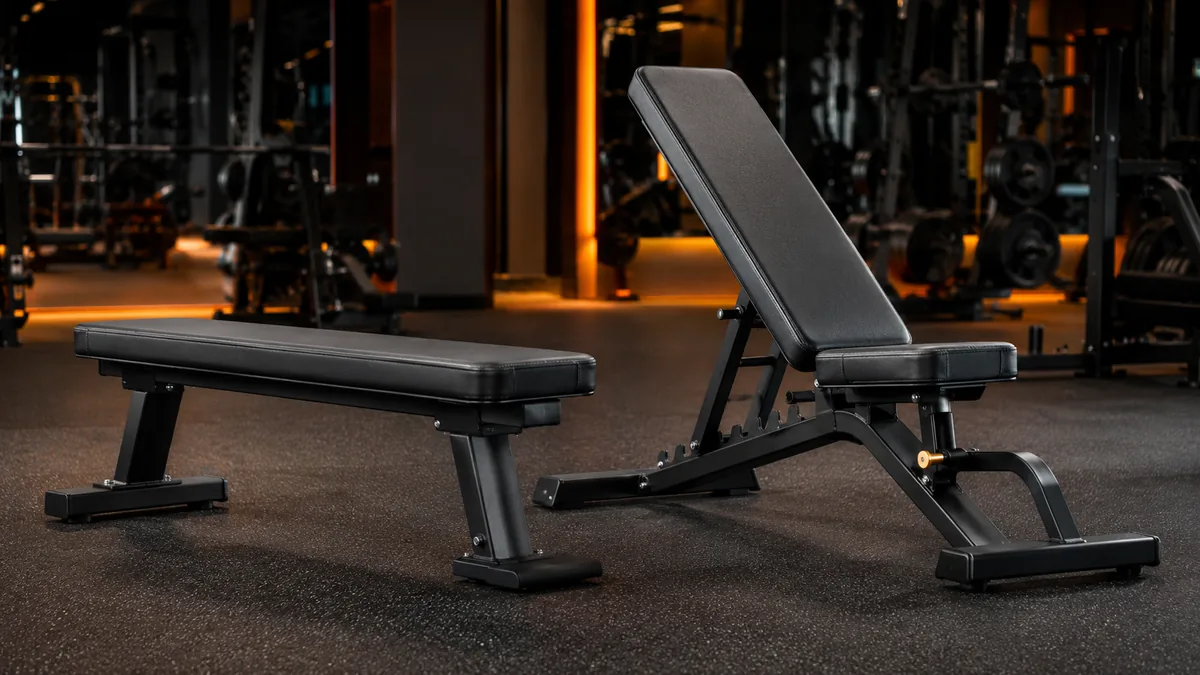
The flat bench press activates the entire pectoralis major evenly. According to EMG studies, the incline bench press at 30 to 45 degrees substantially increases upper-chest activation. Many training plans combine both variations to cover different pressing angles.
What the angle changes
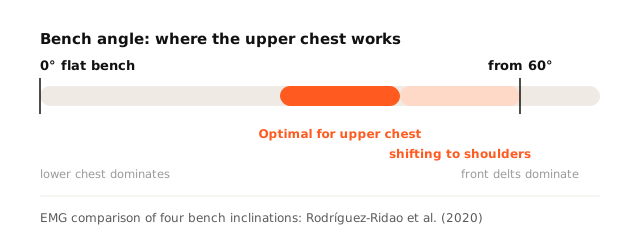
The pectoralis major has two parts: the sternal head (lower/middle chest) and the clavicular head (upper chest). As the bench angle changes, the load shifts between the two. The flat bench press primarily activates the sternal head, while incline pressing from roughly 30 degrees upward increasingly recruits the clavicular head. From 60 degrees on, the front delts take over the movement.
EMG activation compared
| Exercise | Upper-chest activation |
|---|---|
| Flat bench (0°) | Low |
| Incline bench 30° | High |
| Incline bench 45° | Very high |
| Incline bench 60°+ | High, but shoulder-dominant |
What the studies show
An EMG study by Rodríguez-Ridao et al. (2020) in the International Journal of Environmental Research and Public Health compared four bench inclinations. Upper-chest activity peaked at 30 degrees — at 45 degrees, upper-chest activity was marginally higher still, but the load shifted more strongly toward the shoulders. At 0 degrees, the lower chest dominated. For targeted upper-chest training, the 30–45 degree range is therefore considered optimal.
Combining both in your program
For complete chest development, the NSCA recommends combining flat and incline pressing across your training week. Typical setups:
- Push-day approach: flat bench as the main exercise, incline bench as the second exercise.
- Two chest sessions per week: session A focused on the flat bench, session B focused on the incline bench.
- Chest once per week: three to four sets of flat bench followed by three sets of incline bench.
The decline bench: mostly unnecessary
According to EMG data, the decline bench press activates the lower chest slightly more than the flat bench — but only marginally. The head-down position also raises the risk of a blood pressure spike and is harder to set up in many home gyms. The ISSN and NSCA recommend using the decline bench only as a variation — not as a main exercise.
Dumbbell or barbell?
Dumbbell pressing on the incline bench adds an extra stretch at the bottom thanks to the greater range of motion. A study by Saeterbakken et al. (2017) showed comparable hypertrophy results for dumbbell and barbell variations. Dumbbells allow a more natural shoulder position and are easier on the joints for many lifters — especially those with a history of shoulder problems.
Log your workouts in 5 seconds with GymLog AI
GymLog AI recognizes flat and incline variations and counts your chest volume per angle toward your weekly plan.
Download on the App StoreSources
- Rodríguez-Ridao, D., et al. (2020). Effect of Five Bench Inclinations on the Electromyographic Activity of the Pectoralis Major, Anterior Deltoid, and Triceps Brachii during the Bench Press Exercise. Int J Environ Res Public Health. PubMed
- Chaves, S. F. N., et al. (2020). Effects of bench press exercise at different inclinations on muscle activation. Revista Brasileira de Cineantropometria. Article
- Saeterbakken, A. H., et al. (2017). Effects of barbell bench press with different grip widths on muscle activity. JSCR. PubMed
- NSCA. Essentials of Strength Training and Conditioning. nsca.com