How many meals per day are optimal?

Meal frequency itself usually has only a minor effect. In practice, most people land on three to five protein-rich meals spread across the day, depending on their schedule.
The old assumption
For a long time, the standard advice was to eat six to eight small meals a day to "fire up" the metabolism and support muscle growth. That idea rested on the assumption of an elevated thermic effect of food. Current research shows the thermic effect depends primarily on total calorie and protein intake, not on the number of meals itself (Bellisle et al., 1997).
What the evidence says about frequency
In a meta-regression, Schoenfeld et al. (2015) analyzed 15 studies on the influence of meal frequency on body composition and found a statistically negligible effect. The takeaway: total daily calorie and protein intake matters more than whether you spread it across many meals or few. Cameron et al. (2010) likewise found no significant difference in weight loss between three and six meals per day in a randomized diet study with matched calorie intake.
The optimal frequency for protein synthesis
In a controlled study, Areta et al. (2013) examined how muscle protein synthesis responded to three different protein distributions over 12 hours: four moderate meals (20 g each), two large meals (40 g each), or eight small meals (10 g each). In this study, the four-moderate-meals pattern produced the largest effect on the measured synthesis rate. The study supports the now-common recommendation of three to five protein-containing meals across the day.
Putting it into practice
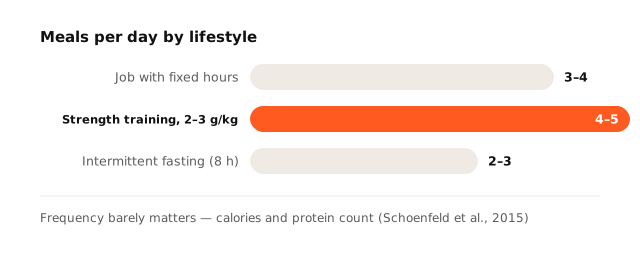
| Lifestyle | Recommendation |
|---|---|
| Job with fixed hours | 3–4 meals |
| Strength training with 2–3 g/kg protein | 4–5 meals |
| Intermittent fasting (8 h window) | 2–3 meals |
What actually matters
Personal preference and your daily routine determine the meal count that makes sense. If you hit your calorie and protein targets with three meals, you are at no disadvantage compared with someone eating six. In practice, three to five protein-rich meals spread across your waking hours is the common pattern.
Start tracking your calories with GymLog AI
GymLog AI logs your meals flexibly — whether you eat three or six a day.
Download on the App StoreSources
- Schoenfeld, B. J., et al. (2015). Effects of meal frequency on weight loss and body composition: a meta-analysis. Nutr Rev, 73(2). PubMed
- Areta, J. L., et al. (2013). Timing and distribution of protein ingestion during prolonged recovery from resistance exercise alters myofibrillar protein synthesis. J Physiol, 591(9). PubMed
- Cameron, J. D., et al. (2010). Increased meal frequency does not promote greater weight loss. Br J Nutr, 103(8). PubMed
- Bellisle, F., et al. (1997). Meal frequency and energy balance. Br J Nutr, 77 Suppl 1. PubMed