Is intermittent fasting good for weight loss?

Intermittent fasting produces the same weight loss as a conventional diet with an identical calorie deficit. Its advantage is not some special metabolic effect — it is how easy it is to stick to in practice.
The three main approaches
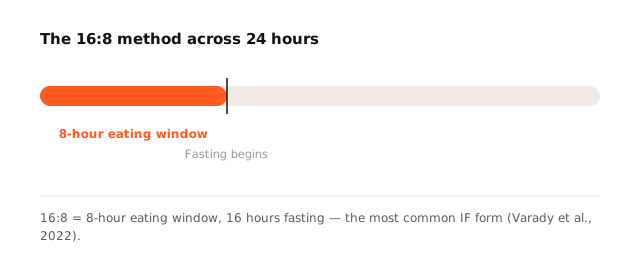
Intermittent fasting is an umbrella term for several time-restricted eating patterns. The most common are the 16:8 method (16 hours of fasting, an 8-hour eating window), the 5:2 method (two days per week of sharply reduced intake, around 500–600 kcal), and alternate-day fasting (alternating normal days with heavily restricted ones).
What the evidence shows
Varady et al. (2022) reviewed eleven randomized trials and found comparable weight loss between intermittent fasting and conventional diets matched for calorie deficit. A controlled trial by Lowe et al. (2020) with 116 participants found no significant advantage for 16:8 over a regular eating pattern without time restriction. The current evidence suggests the real mechanism is simply a calorie deficit — one that often emerges spontaneously when the eating window shrinks.
Potential real-world advantages
Moro et al. (2016) studied 16:8 in strength athletes and documented a reduction in fat mass with muscle mass remaining stable. A review by Welton et al. (2020) observed changes in individual metabolic markers — but in those studies the same changes also showed up with conventional dieting, as long as the deficit was the same. The authors note that simplifying meal planning and skipping breakfast can improve adherence for some people.
Limitations and risks
In a study with strength athletes, Tinsley et al. (2019) flagged an elevated risk of falling short on total protein intake during intermittent fasting if the eating window is not used consistently for protein-rich meals. For lifters chasing muscle growth, the literature recommends at least three protein-containing meals within the 8-hour window. Anyone with individual health concerns should get professional advice before starting intermittent fasting.
Plan your deficit with GymLog AI
GymLog AI tracks your meals no matter what your eating window looks like and helps you distribute protein during IF.
Download on the App StoreSources
- Varady, K. A., et al. (2022). Clinical application of intermittent fasting for weight loss: progress and future directions. Nat Rev Endocrinol, 18(5). PubMed
- Lowe, D. A., et al. (2020). Effects of Time-Restricted Eating on Weight Loss and Other Metabolic Parameters in Women and Men With Overweight and Obesity. JAMA Intern Med, 180(11). PubMed
- Moro, T., et al. (2016). Effects of eight weeks of time-restricted feeding (16/8) on basal metabolism, maximal strength, body composition. J Transl Med, 14:290. PubMed
- Tinsley, G. M., et al. (2019). Time-restricted feeding plus resistance training in active females. Am J Clin Nutr, 110(3). PubMed
- Welton, S., et al. (2020). Intermittent fasting and weight loss: Systematic review. Can Fam Physician, 66(2). PubMed