How big should your calorie deficit be?

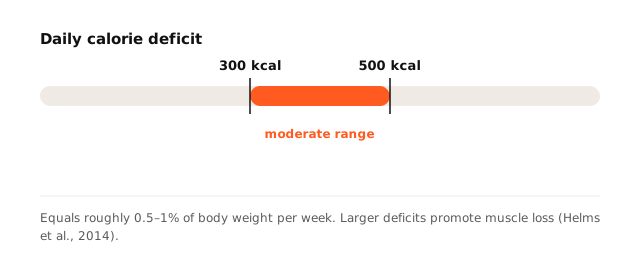
A moderate calorie deficit of 300 to 500 kcal per day is frequently cited as a workable range. It corresponds to losing roughly 0.5 to 1 percent of your body weight per week.
Weight loss timeline calculator
Estimate based on 1 kg of body fat ≈ 7,700 kcal (Hall et al., 2011).
The moderate range
A deficit of 300 to 500 kcal below total daily energy expenditure translates to a fat loss of roughly 0.3 to 0.5 kg (0.7–1.1 lb) per week. Helms et al. (2014) discuss this range in their review as a practical approach for dieting phases.
Steeper deficits come with downsides
In a controlled study, Garthe et al. (2011) compared a moderate deficit (0.7 percent weight loss per week) with an aggressive one (1.4 percent). Individual studies have shown more favorable outcomes with moderate deficits than with aggressive ones.
| Pace | Recommendation |
|---|---|
| Slow (0.5%/week) | 300 kcal deficit |
| Moderate (0.7%/week) | 400–500 kcal |
| Aggressive (1%/week) | 500–700 kcal (short-term only) |
Plan your deficit with GymLog AI
GymLog AI calculates your individual target deficit and warns you when you drift too far off course.
Download on the App StoreSources
- Helms, E. R., et al. (2014). Evidence-based recommendations for natural bodybuilding contest preparation: nutrition and supplementation. JISSN, 11:20. jissn.biomedcentral.com
- Garthe, I., et al. (2011). Effect of two different weight-loss rates on body composition and strength and power-related performance in elite athletes. Int J Sport Nutr Exerc Metab, 21(2). PubMed