How many calories do you need per day?

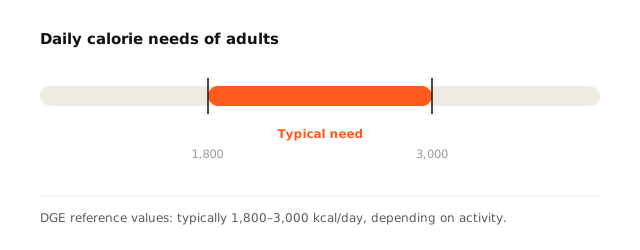
Your daily calorie needs equal your basal metabolic rate multiplied by an activity factor (PAL). According to reference values from the German Nutrition Society (DGE), adults typically need between 1,800 and 3,000 kilocalories per day.
Calorie calculator
Mifflin-St Jeor formula with activity factor (PAL).
The two components of energy needs
Total energy expenditure is made up of your basal metabolic rate and your activity-related expenditure. BMR describes the energy your body burns at rest — for breathing, circulation, cellular metabolism, and maintaining body temperature. For most adults, it accounts for the bulk of daily energy needs (Speakman & Selman, 2003).
The Mifflin-St Jeor equation as the scientific standard
The equation established in clinical guidelines for estimating BMR comes from Mifflin et al. (1990). In the validation study by Frankenfield et al. (2005), it proved more accurate than the older Harris-Benedict equation and is now the standard basis for calculating energy needs.
Women: 10 × kg + 6.25 × cm − 5 × age − 161
The DGE's PAL factors
To get your total energy needs, you multiply BMR by a PAL factor (Physical Activity Level). The German Nutrition Society provides the following reference values:
| Activity | PAL factor |
|---|---|
| Mostly sedentary | 1.4 |
| Sedentary with some movement | 1.6 |
| Mostly standing or walking | 1.8 |
Why equation results are only an approximation
Equation-based calculations reflect the statistical average of a population. Individual factors such as muscle mass, genetic variation in resting metabolism, and non-exercise everyday activity (NEAT) can shift actual needs up or down by several hundred kilocalories, according to Levine (2002). Consistently logging your food intake for two to three weeks alongside your weight trend gives you a more reliable individual number.
Start tracking your calories with GymLog AI
GymLog AI calculates your BMR automatically and logs your energy intake via photo or chat.
Download on the App StoreSources
- Mifflin, M. D., et al. (1990). A new predictive equation for resting energy expenditure in healthy individuals. Am J Clin Nutr, 51(2). PubMed
- Frankenfield, D., et al. (2005). Comparison of predictive equations for resting metabolic rate in healthy nonobese and obese adults. J Am Diet Assoc. PubMed
- Speakman, J. R., & Selman, C. (2003). Physical activity and resting metabolic rate. Proc Nutr Soc, 62(3).
- Levine, J. A. (2002). Non-exercise activity thermogenesis (NEAT). Best Pract Res Clin Endocrinol Metab, 16(4).
- German Nutrition Society (DGE). Reference values for energy intake. dge.de