What is NEAT?

NEAT (Non-Exercise Activity Thermogenesis) is the energy you burn through unconscious everyday movement — walking, gesturing, climbing stairs, holding posture. It can add up to several hundred calories per day.
Definition
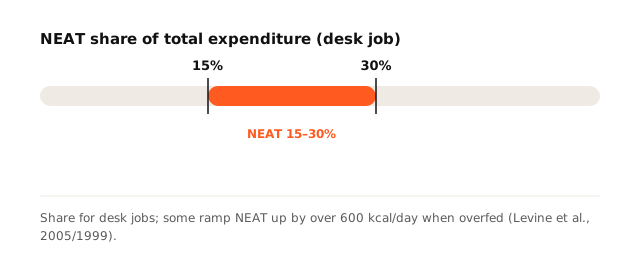
The term was coined by James Levine. NEAT covers the energy spent on every activity that is neither sleep nor deliberate exercise: walking, standing, fidgeting while seated, gesturing, taking the stairs, doing housework (Levine et al., 2005). For people with desk jobs, NEAT accounts for roughly 15 to 30 percent of total daily energy expenditure.
How much it varies between people
The NEAT response to a calorie surplus varies enormously: in a controlled overfeeding study, some participants ramped up their NEAT by more than 600 kcal per day, while others barely budged (Levine et al., 1999). This variability explains why some people gain less weight than others on the exact same diet.
NEAT in a calorie deficit
In a calorie deficit, NEAT often drops without you noticing, which lowers your total energy expenditure. This effect is part of adaptive thermogenesis (Müller et al., 2016). Dieters simply move less throughout the day — without ever consciously registering it.
Plan your deficit with GymLog AI
GymLog AI reminds you to take movement breaks during a deficit and tracks your everyday activity.
Download on the App StoreSources
- Levine, J. A., et al. (2005). Interindividual variation in posture allocation: possible role in human obesity. Science, 307(5709). PubMed
- Levine, J. A., et al. (1999). Role of nonexercise activity thermogenesis in resistance to fat gain in humans. Science, 283(5399). PubMed
- Müller, M. J., et al. (2016). Adaptive thermogenesis with weight loss in humans. Obesity, 24(1). PubMed