How do you calculate your basal metabolic rate?

For healthy adults, basal metabolic rate (BMR) is most reliably calculated with the Mifflin-St Jeor equation, which factors in sex, weight, height, and age.
Calorie calculator
Mifflin-St Jeor formula with activity factor (PAL).
The Mifflin-St Jeor equation
The equation was developed by Mifflin et al. in 1990 and, according to a validation study by the Academy of Nutrition and Dietetics (Frankenfield et al., 2005), is the most accurate method for estimating basal metabolic rate in healthy adults of normal weight as well as those who are overweight.
| Sex | Equation |
|---|---|
| Men | 10 × kg + 6.25 × cm − 5 × age + 5 |
| Women | 10 × kg + 6.25 × cm − 5 × age − 161 |
Calculating your total daily energy expenditure
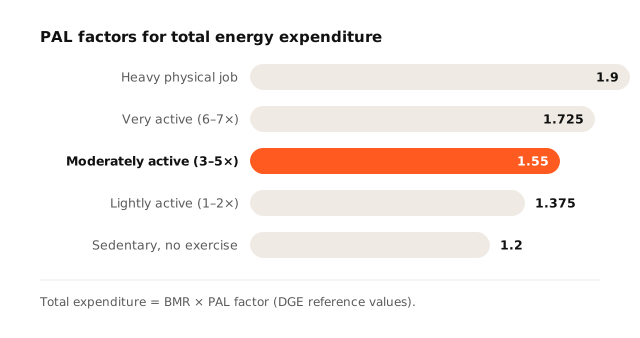
Basal metabolic rate only describes the energy you burn at rest. To get your total daily energy expenditure, you multiply your BMR by your PAL value (Physical Activity Level), which reflects your physical activity. The German Nutrition Society (DGE) uses PAL values ranging from 1.2 for an exclusively sedentary lifestyle to 1.9 for heavy physical labor.
Start tracking your calories with GymLog AI
GymLog AI calculates your BMR and total energy expenditure individually and automatically adjusts your targets as your weight changes.
Download on the App StoreSources
- Mifflin, M. D., et al. (1990). A new predictive equation for resting energy expenditure in healthy individuals. Am J Clin Nutr, 51(2). PubMed
- Frankenfield, D., et al. (2005). Comparison of predictive equations for resting metabolic rate in healthy nonobese and obese adults: a systematic review. J Am Diet Assoc, 105(5). PubMed
- German Nutrition Society (DGE). Reference values for energy intake. dge.de