How many sets per muscle group per week?

For muscle growth, 10 to 20 working sets per muscle group per week is the guideline supported by research. According to the largest meta-regression to date, more sets bring further, but diminishing, gains.
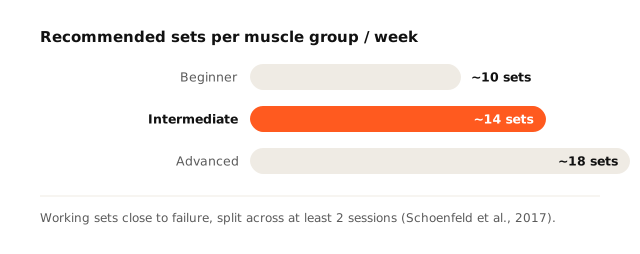
Sets per muscle group
Guideline values within the 10–20 set range from research, split across your training days.
What the research says about training volume
The meta-analysis by Schoenfeld et al. (2017) examined 15 studies on the relationship between weekly set volume and muscle growth. The result is a graded dose-response relationship: more working sets per week go along with more hypertrophy. The systematic review by Baz-Valle et al. (2022) names 12 to 20 sets per muscle group per week as a possible standard recommendation for young, trained men. The American College of Sports Medicine (2026) states that at least 10 sets per muscle group per week enhance muscle growth.
What counts as a working set
A working set is one that ends with high effort close to muscle failure. The ACSM (2026) gives ending near failure or at 2 to 3 reps in reserve as the target. Warm-up sets do not count toward effective training volume.
Guidelines from research
| Weekly volume | Basis |
|---|---|
| at least 10 sets | enhances muscle growth (ACSM, 2026) |
| 12–20 sets | guideline for young, trained men (Baz-Valle et al., 2022) |
Is there an upper limit?
The largest meta-regression to date, Pelland et al. (2026) with 67 studies, finds more muscle growth with more volume, but with diminishing returns per additional set. No clear plateau could be identified. Above roughly 25 sets per week (indirect sets counted as half), however, there are only a few studies, so uncertainty is high there. For program design, that means more volume does not automatically translate into proportionally more muscle.
Log your workout with GymLog AI in 5 seconds
GymLog AI automatically counts working sets per muscle group and shows your weekly volume at a glance.
Download on the App StoreGet it on Google PlaySources
- Schoenfeld, B. J., Ogborn, D. & Krieger, J. W. (2017). Dose-response relationship between weekly resistance training volume and increases in muscle mass: A systematic review and meta-analysis. Journal of Sports Sciences, 35(11), 1073–1082. PubMed
- Baz-Valle, E., Balsalobre-Fernández, C., Alix-Fages, C. & Santos-Concejero, J. (2022). A Systematic Review of The Effects of Different Resistance Training Volumes on Muscle Hypertrophy. Journal of Human Kinetics, 81, 199–210. PubMed
- Pelland, J. C., Remmert, J. F., Robinson, Z. P., Hinson, S. R. & Zourdos, M. C. (2026). The Resistance Training Dose Response: Meta-Regressions Exploring the Effects of Weekly Volume and Frequency on Muscle Hypertrophy and Strength Gains. Sports Medicine, 56(2), 481–505. PubMed
- Currier, B. S., et al. (American College of Sports Medicine) (2026). Resistance Training Prescription for Muscle Function, Hypertrophy, and Physical Performance in Healthy Adults: An Overview of Reviews. Medicine & Science in Sports & Exercise, 58(4), 851–872. PubMed
- Schoenfeld, B. J., Grgic, J. & Krieger, J. (2019). How many times per week should a muscle be trained to maximize muscle hypertrophy? A systematic review and meta-analysis of studies examining the effects of resistance training frequency. Journal of Sports Sciences, 37(11), 1286–1295. PubMed