How much protein do you need per day?
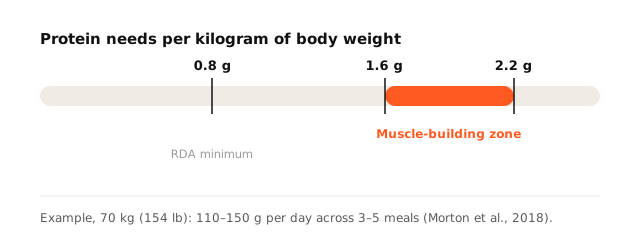
For muscle growth, a range of roughly 1.6 to 2.2 grams of protein per kilogram of body weight is commonly discussed. For someone weighing 70 kg (154 lb), that works out to around 110 to 150 grams per day, spread across several meals.
Protein calculator
Evidence-based range per the ISSN position stand (Jäger et al., 2017).
The DGE recommendation only covers baseline needs
The German Nutrition Society (DGE) recommends 0.8 grams of protein per kilogram of body weight for healthy adults who do not exercise regularly. That figure represents the minimum needed to cover essential bodily functions — not the range commonly discussed in strength sports.
What the research says for strength athletes
The meta-analysis by Morton et al. (2018) evaluated data from 49 controlled studies with 1,863 participants. The results show that the additional benefit for muscle growth plateaus at around 1.62 grams of protein per kilogram of body weight. In its current position stand, the International Society of Sports Nutrition recommends a range of 1.4 to 2.0 g/kg — and even more for athletes in a calorie deficit (Jäger et al., 2017).
Recommendation by goal
| Goal | Protein target |
|---|---|
| Maintenance without exercise | 0.8 g/kg |
| Muscle growth | 1.6–2.0 g/kg |
| Calorie deficit | 2.0–2.4 g/kg |
Spreading it across the day
For building muscle, total daily intake matters more than the exact timing of individual meals. Studies on muscle protein synthesis show, however, that splitting your protein across three to five meals of 20 to 40 grams each allows a more even activation of synthesis than one single large serving (Schoenfeld & Aragon, 2018).
Keep your protein on track with GymLog AI
GymLog AI calculates your individual protein target and logs every meal via photo or chat.
Download on the App StoreSources
- Morton, R. W., et al. (2018). A systematic review, meta-analysis and meta-regression of the effect of protein supplementation on resistance training-induced gains in muscle mass and strength. British Journal of Sports Medicine, 52(6). PubMed
- Jäger, R., et al. (2017). International Society of Sports Nutrition Position Stand: Protein and Exercise. JISSN, 14:20. PubMed
- Schoenfeld, B. J., & Aragon, A. A. (2018). How much protein can the body use in a single meal for muscle-building? JISSN, 15:10. jissn.biomedcentral.com
- Kreider, R. B., et al. (2017). ISSN position stand: safety and efficacy of creatine supplementation. JISSN, 14:18.
- German Nutrition Society (DGE). Reference values for protein intake. dge.de