How many calories are in milk?
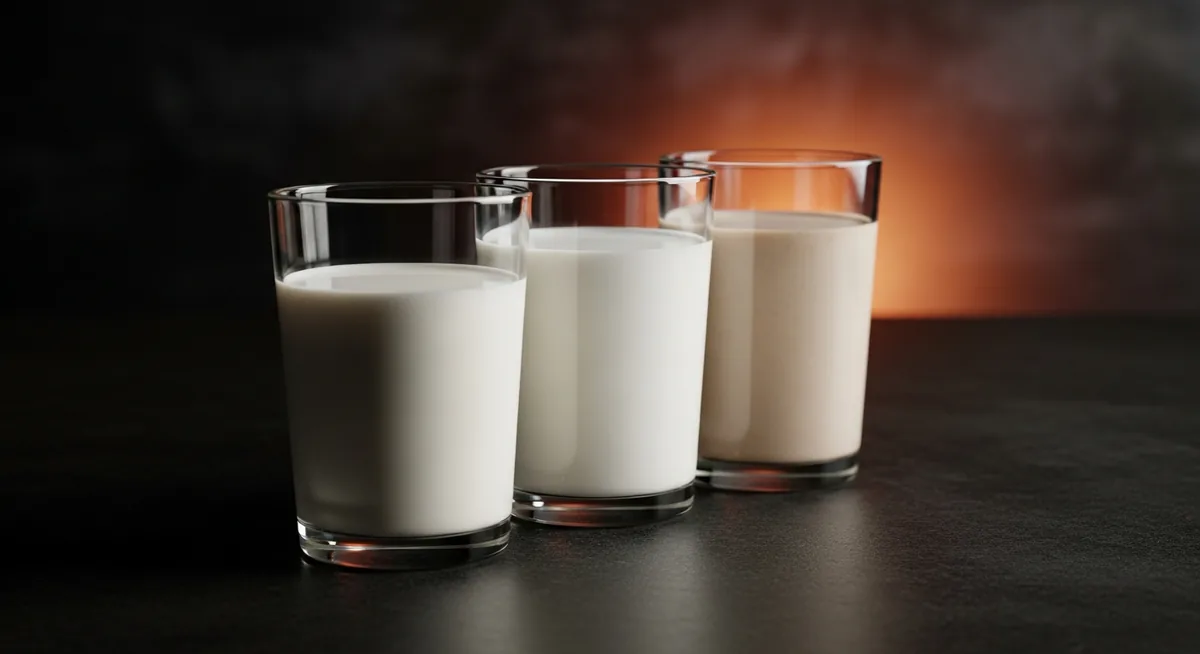
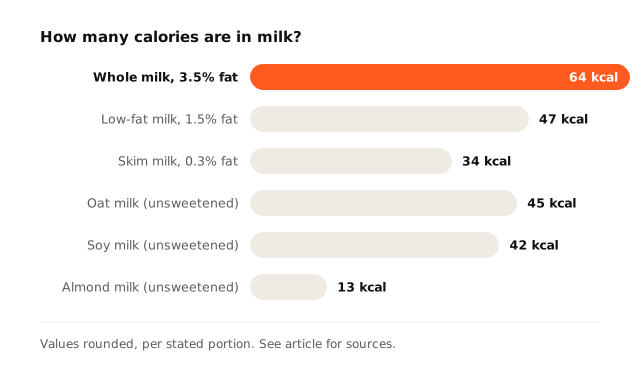
According to the German BLS food database, 100 ml (3.4 fl oz) of whole milk (3.5% fat) deliver around 64 calories. Low-fat milk at 1.5% comes to 47 calories, skim milk at 0.3% to 34 calories. Plant-based drinks range from 13 to 68 calories per 100 ml, depending on the variety.
Cow's milk and plant-based drinks compared
| Drink (100 ml) | Calories |
|---|---|
| Whole milk, 3.5% fat | 64 kcal |
| Low-fat milk, 1.5% fat | 47 kcal |
| Skim milk, 0.3% fat | 34 kcal |
| Oat milk (unsweetened) | 45 kcal |
| Soy milk (unsweetened) | 42 kcal |
| Almond milk (unsweetened) | 13 kcal |
| Rice milk | 50 kcal |
| Coconut milk drink | 22 kcal |
Protein is the deciding difference
Even though the calorie counts of some plant-based drinks do not differ much from cow's milk, the biggest gap shows up in protein. Whole and low-fat milk contain around 3.4 grams of protein per 100 ml. Soy milk reaches a nearly identical level at around 3.3 grams, while oat, almond, and rice milk lag far behind at 0.3 to 1.0 grams.
Milk and muscle growth
Milk protein is roughly 80 percent casein and 20 percent whey protein. A study by Wilkinson et al. (2007) showed that skim milk triggers greater muscle protein synthesis after strength training than soy protein at an identical protein dose. In its position stand, the ISSN names milk as a practical and inexpensive protein source for strength athletes — 500 ml of skim milk deliver around 17 grams of protein for 170 calories.
Lactose and sugar calories
Cow's milk contains around 4.8 grams of lactose per 100 ml, which accounts for roughly 30 percent of the total calories in whole milk. According to Germany’s Federal Institute for Risk Assessment (BfR), lactose-free milk has an identical calorie density — the lactose is simply split enzymatically into glucose and galactose, and the energy stays the same.
Start tracking calories with GymLog AI
GymLog AI automatically tells cow's milk from plant-based drinks and converts your coffee, porridge, or shake into your daily budget in seconds.
Download on the App StoreSources
- USDA FoodData Central. Milk, whole, 3.25% milkfat. fdc.nal.usda.gov
- Max Rubner Institute. Bundeslebensmittelschlüssel (BLS), version 3.02 — Germany’s national food composition database. blsdb.de
- Wilkinson, S. B., et al. (2007). Consumption of fluid skim milk promotes greater muscle protein accretion after resistance exercise than does consumption of an isonitrogenous and isoenergetic soy-protein beverage. Am J Clin Nutr. PubMed
- Jäger, R., et al. (2017). International Society of Sports Nutrition Position Stand: protein and exercise. JISSN. PubMed
- Federal Institute for Risk Assessment (BfR), Germany. Lactose and lactose-free foods. bfr.bund.de