Mind-muscle connection: does it actually work?

Consciously focusing on the target muscle measurably increases muscle activity in isolation exercises. With heavy compound lifts and in advanced athletes, the effect is smaller. The mind-muscle connection is most often cited as a hypertrophy tool for isolation work; for maximal strength it usually plays a minor role.
What the mind-muscle connection means
The mind-muscle connection (MMC) describes deliberately directing your mental focus toward the working muscle during an exercise. Instead of just moving the weight, you concentrate on actively contracting the target muscle and driving the movement primarily from it. The opposite is an "external focus" — attention on the weight, the movement, or an outside target.
The state of the evidence
| Scenario | Effect on muscle activity |
|---|---|
| Isolation exercise, light load | Clearly higher |
| Isolation exercise, heavy load (>80% 1RM) | Small effect |
| Compound exercise, light load | Moderate |
| Compound exercise, heavy load | Barely any effect |
What the studies show
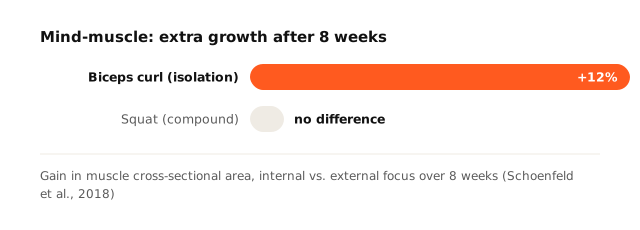
Schoenfeld et al. (2018), in the European Journal of Sport Science, compared two groups over eight weeks: one focusing on the target muscle (internal focus), the other on the weight (external focus). On the biceps curl, the MMC group showed a 12 percent greater increase in biceps cross-sectional area. On the squat, there was no significant difference between groups. The result lines up with earlier EMG work by Calatayud et al. (2016), which demonstrated clearly elevated EMG activity with mental focus in isolation exercises.
How to use it in practice
For isolation exercises like biceps curls, triceps pushdowns, lateral raises, leg extensions, or lat rows, deliberately focusing on the working muscle is worth it. For compound lifts like the squat, deadlift, and bench press, technique and coordination matter more than muscular focus — here, an external focus on the movement actually improves maximal strength, according to Wulf (2013).
Who benefits most
According to Calatayud et al. (2016), beginners get less out of the MMC because they're still too occupied with coordinating the movement itself. Advanced lifters with solid technique can use mental focus to load the target muscles more deliberately — an additional stimulus mechanism for muscle growth.
Log your workouts in 5 seconds with GymLog AI
GymLog AI distinguishes isolation and compound exercises and helps you apply focus deliberately — instead of training every exercise the same way.
Download on the App StoreSources
- Schoenfeld, B. J., et al. (2018). Differential effects of attentional focus strategies during long-term resistance training. Eur J Sport Sci. PubMed
- Calatayud, J., et al. (2016). Importance of mind-muscle connection during progressive resistance training. Eur J Appl Physiol. PubMed
- Wulf, G. (2013). Attentional focus and motor learning: a review of 15 years. Int Rev Sport Exerc Psychol. Article
- NSCA. Essentials of Strength Training and Conditioning. nsca.com