Should you take a deload week?

Planned recovery phases every 4 to 8 weeks can support long-term progress by clearing accumulated fatigue without sacrificing training adaptations.
The principle of planned recovery
A deload week is a planned reduction in training volume, intensity, or both — typically lasting 5 to 7 days. The rationale comes from Banister's fitness-fatigue model (1991), which holds that your measurable performance is the difference between accumulated fitness and accumulated fatigue. Because fatigue dissipates faster than fitness, a short recovery phase produces a temporary performance peak — the so-called supercompensation effect.
What does the research say?
Direct randomized trials on deload weeks in strength training are limited. The evidence rests mostly on tapering studies from endurance sports and on volume research. Pritchard et al. (2015) showed in a systematic review that cutting training volume by 40 to 60% while keeping intensity constant for 1 to 2 weeks optimizes strength performance. The key point: training intensity (the weight on the bar) should stay where it is — only the volume (sets) comes down.
Ogasawara et al. (2013) studied periodized training with built-in breaks and found that 3 weeks of training followed by 1 week off, repeated over 24 weeks, produced hypertrophy results comparable to continuous training. This suggests that short recovery phases don't cost you any training adaptations.
How to set up a deload
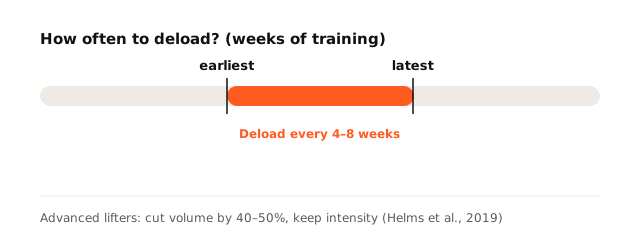
Helms, Morgan and Valdez (2019) recommend a deload every 4 to 8 weeks for advanced lifters, depending on training intensity and individual recovery capacity. The most common method: cut volume by 40 to 50%, keep the weight, and leave training frequency unchanged. Beginners need deloads less often because they recover faster.
| Method | Volume | Intensity |
|---|---|---|
| Volume deload (recommended) | −40 to −50% | unchanged |
| Intensity deload | unchanged | −10 to −20% |
Log your workouts in 5 seconds with GymLog AI
GymLog AI spots fatigue patterns and automatically suggests a deload when you need one.
Download on the App StoreSources
- Pritchard, H. J., et al. (2015). Tapering Practices of New Zealand’s Elite Raw Powerlifters. Journal of Strength and Conditioning Research, 29(7), 1790–1799. PubMed
- Ogasawara, R., et al. (2013). Comparison of Muscle Hypertrophy Following 6-Month of Continuous and Periodic Strength Training. European Journal of Applied Physiology, 113(4), 975–985. PubMed
- Helms, E. R., Morgan, A. & Valdez, A. (2019). The Muscle and Strength Pyramid: Training. 2nd edition.
- Banister, E. W. (1991). Modeling Elite Athletic Performance. In: Physiological Testing of the High-Performance Athlete, Human Kinetics, 403–424.