How many calories are in 1 kg of body fat?

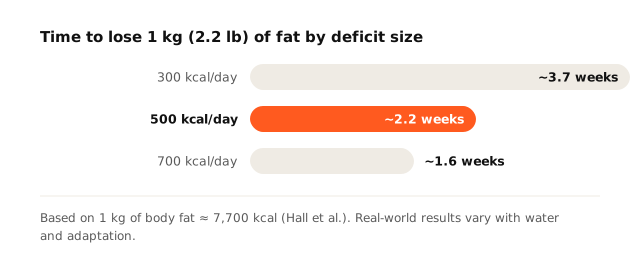
One kilogram (2.2 lb) of body fat equals roughly 7,700 calories. Treat the number as an approximation: fat tissue contains water and connective tissue alongside pure fat.
The back-of-the-envelope math
Pure fat delivers around 9 kcal per gram — 9,000 kcal per kilogram (2.2 lb). But body fat tissue is not 100 percent pure fat; it also contains water, proteins, and connective tissue. Wishnofsky (1958) estimated the energy content of body fat tissue at roughly 7,700 kcal per kilogram — a figure that has served as the practical rule of thumb ever since.
Why the math doesn't quite hold up in real life
Hall et al. (2008) point out that real-world weight change in a calorie deficit is more dynamic. Especially in the first weeks, the number on the scale reflects not just fat loss but also losses of glycogen and the water bound to it. Cutting 3,850 kcal per week therefore does not automatically translate into exactly 0.5 kg (1.1 lb) of fat loss — over the long run, though, the balance converges toward the estimate.
Plan your deficit with GymLog AI
GymLog AI shows realistic timelines to your goal weight and factors in the typical metabolic adaptations.
Download on the App StoreSources
- Wishnofsky, M. (1958). Caloric equivalents of gained or lost weight. Am J Clin Nutr, 6(5). PubMed
- Hall, K. D. (2008). What is the required energy deficit per unit weight loss? Int J Obes (Lond), 32(3). PubMed
- Hall, K. D., et al. (2011). Quantification of the effect of energy imbalance on bodyweight. Lancet, 378(9793). PubMed