How many calories are in a banana?
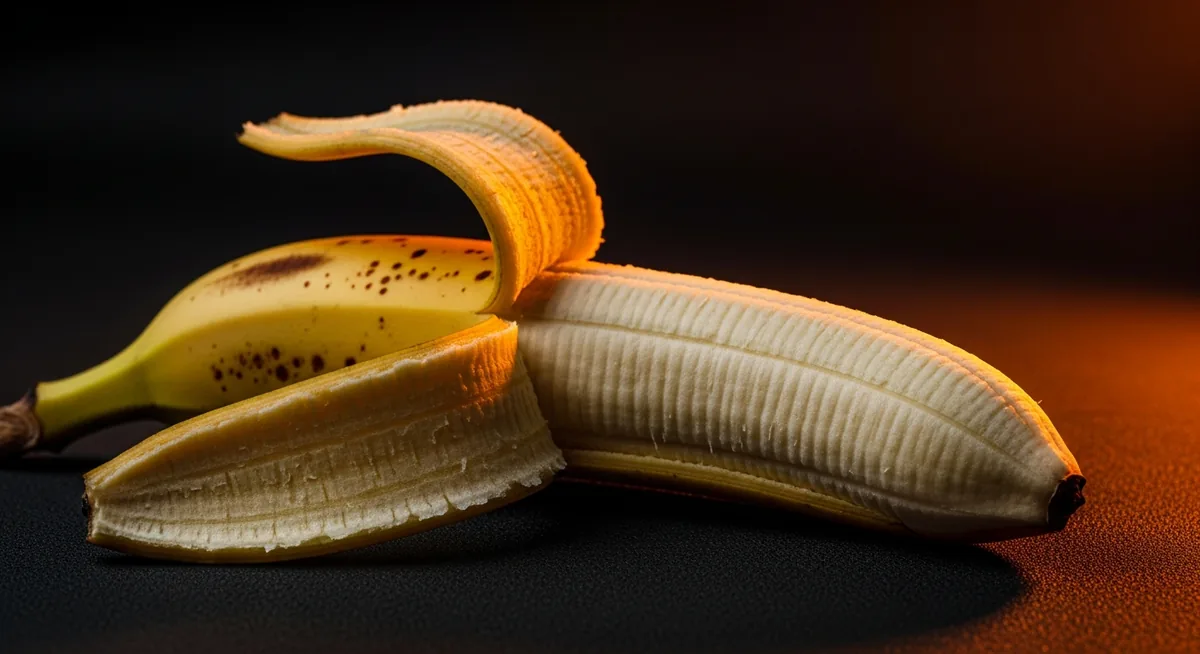
A medium banana (peeled) weighing 118 grams (4.2 oz) contains around 105 calories, according to USDA FoodData Central. That works out to 89 calories per 100 grams (3.5 oz) of fruit flesh.
Your own meal? Snap a photo – the AI estimates calories and macros in seconds. 3 free scans a day, no sign-up.
Keep scanning in the GymLog AI app – with daily targets and history.
Get the app for free →Banana nutrition facts
According to German BLS data, the banana is one of the most carbohydrate-rich fresh fruits. Per 100 grams of fruit flesh, it contains 22.8 grams of carbohydrate, including 12.2 grams of sugar and 2.6 grams of fiber. Protein comes in at 1.1 grams and fat at 0.3 grams. Potassium is its standout micronutrient, at 358 milligrams per 100 grams.
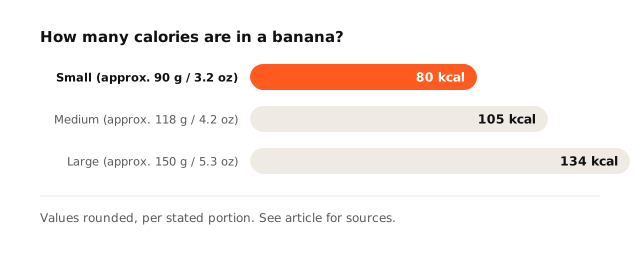
Calories by size
According to Germany's Federal Center for Nutrition (BZfE), the flesh of a typical store-bought banana weighs between 80 and 150 grams, depending on size. The peel accounts for about a third of the total weight.
| Size (fruit flesh) | Calories |
|---|---|
| Small (approx. 90 g / 3.2 oz) | 80 kcal |
| Medium (approx. 118 g / 4.2 oz) | 105 kcal |
| Large (approx. 150 g / 5.3 oz) | 134 kcal |
Does ripeness matter?
As a banana ripens, its total energy content doesn't change — but the makeup of its carbohydrates does. Unripe green bananas contain up to 80 percent resistant starch, which isn't fully digested in the small intestine and is instead fermented in the colon (Robertson et al., 2005). In ripe yellow bananas, most of that starch has been converted to sugar, which the body uses directly for energy. Nutrition labels typically list the fully available energy of a ripe banana.
Banana vs. other fruits
Compared to other commonly eaten fruits, the banana is more calorie-dense, owing to its higher carbohydrate content and lower water content. Per German BLS data, 100 grams of apple deliver 52 calories and 100 grams of strawberries 32 calories, while 100 grams of banana come to 89 calories. In absolute terms, a medium banana is the energy equivalent of roughly two small apples.
Start tracking calories with GymLog AI
GymLog AI tracks fruit, snacks, and complete meals in seconds — by photo or chat.
Download on the App StoreGet it on Google PlaySources
- USDA FoodData Central. Bananas, raw. fdc.nal.usda.gov
- Max Rubner Institute. Bundeslebensmittelschlüssel (BLS), version 3.02 — Germany’s national food composition database. blsdb.de
- German Federal Center for Nutrition (BZfE). Bananas — product guide. bzfe.de
- Robertson, M. D., et al. (2005). Insulin-sensitizing effects of dietary resistant starch and effects on skeletal muscle and adipose tissue metabolism. Am J Clin Nutr. PubMed
- Kerksick, C. M., et al. (2018). ISSN exercise & sports nutrition review update: research & recommendations. JISSN, 15:38. PubMed