How many calories are in an egg?

A medium chicken egg of EU size class M (approx. 58 g / 2 oz) contains around 82 calories, according to USDA and German BLS data. Those calories are split very unevenly: the egg white provides just 17 kcal, while the yolk delivers around 65 kcal.
Calories by egg size
The EU weight classes for chicken eggs run from S (under 53 g) to XL (over 73 g) — an EU size M is roughly equivalent to a US large egg. Calorie count scales linearly with the weight of the edible portion.
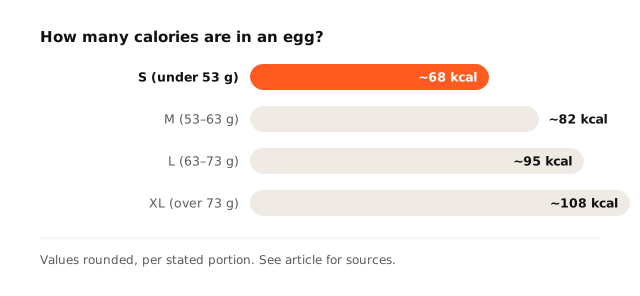
| Size class | Calories (without shell) |
|---|---|
| S (under 53 g) | ~68 kcal |
| M (53–63 g) | ~82 kcal |
| L (63–73 g) | ~95 kcal |
| XL (over 73 g) | ~108 kcal |
Egg white and yolk, separately
The yolk makes up about 33 percent of an egg's total weight but supplies around 80 percent of its calories. According to the USDA, 100 grams of egg yolk contain 322 calories, while 100 grams of egg white sit far lower at 52 calories. The reason: yolk contains around 27 grams of fat per 100 grams, whereas egg white is virtually fat-free and consists almost entirely of water and protein.
How cooking changes the numbers
The cooking method only changes the calorie count when fat is added. A hard- or soft-boiled egg has exactly the same energy content as a raw one. A fried egg cooked in butter, on the other hand, lands between 100 and 130 calories depending on the amount of fat. Scrambled eggs made with 10 ml of milk and a teaspoon of butter per egg come to around 110 calories.
Eggs and muscle growth
In sports science, the chicken egg is considered the gold standard of protein quality. On the classic scale by Thomas and Mitchell, its biological value is 100, defining the reference point for every other protein source. One egg delivers around 6.3 grams of high-quality protein with a complete amino acid profile. In its position stand on protein intake for athletes, the ISSN names the egg as one of the most digestible animal protein sources.
Start tracking calories with GymLog AI
GymLog AI tracks eggs by size class and cooking method, calculating protein, fat, and calories automatically.
Download on the App StoreSources
- USDA FoodData Central. Egg, whole, raw, fresh. fdc.nal.usda.gov
- Max Rubner Institute. Bundeslebensmittelschlüssel (BLS), version 3.02 — Germany’s national food composition database. blsdb.de
- EU marketing standards for eggs, Commission Regulation (EC) No 589/2008. eur-lex.europa.eu
- Jäger, R., et al. (2017). International Society of Sports Nutrition Position Stand: protein and exercise. JISSN. PubMed
- German Federal Center for Nutrition (BZfE). Eggs — product guide and nutrition facts. bzfe.de