How many calories are in beer?
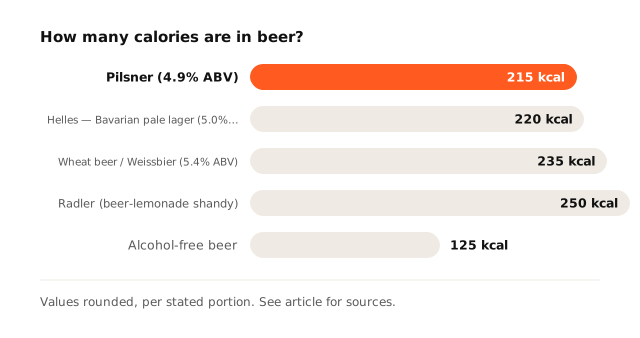
According to the Bundeslebensmittelschlüssel (BLS) — Germany’s national food composition database — a half liter (17 fl oz) of pilsner at 4.9 percent alcohol contains around 215 calories. Wheat beer comes in slightly higher at about 235 calories per 0.5 l, while alcohol-free beer sits at 125 calories.
Where the calories in beer come from
The energy in beer flows from two sources: alcohol and residual carbohydrates. Ethanol delivers 7 calories per gram, according to the German Nutrition Society (DGE) — more than protein or carbohydrate, but less than fat. The carbohydrate share comes from unfermented wort and provides 4 calories per gram. In a typical pilsner, roughly 80 percent of the energy comes from the alcohol.
Calories by beer style
The values below are based on BLS data from the Max Rubner Institute and average product figures from major German breweries.
| Style (0.5 l / 17 fl oz) | Calories |
|---|---|
| Pilsner (4.9% ABV) | 215 kcal |
| Helles — Bavarian pale lager (5.0% ABV) | 220 kcal |
| Wheat beer / Weissbier (5.4% ABV) | 235 kcal |
| Radler (beer-lemonade shandy) | 250 kcal |
| Alcohol-free beer | 125 kcal |
Beer in your daily calorie budget
The energy from beer counts toward your daily calorie balance like any other energy source. In a calorie deficit, beer shrinks the room you have left for the rest of the day’s food accordingly. Alcohol-free beer carries around 40 percent fewer calories per half liter than pilsner or Helles, making it the lower-calorie alternative.
Start tracking calories with GymLog AI
GymLog AI tracks beer and other drinks too — with or without alcohol, logged in seconds via chat.
Download on the App StoreSources
- Max Rubner Institute. Bundeslebensmittelschlüssel (BLS), version 3.02 — Germany’s national food composition database. blsdb.de
- German Nutrition Society (DGE). Energy density of alcohol. dge.de
- German Brewers Association (Deutscher Brauer-Bund). Nutrition information. brauer-bund.de
- German Centre for Addiction Issues (DHS). Alcohol — low-risk consumption. dhs.de