How many calories are in wine?
A glass of wine (0.2 l / 6.8 fl oz) delivers around 140 to 170 calories. Red, white, and rosé land almost identically depending on alcohol content. Alcohol itself provides 7 kcal per gram, according to Germany’s Federal Institute for Risk Assessment (BfR) — nearly as much as fat.
Calories per glass and per 100 ml
The calories in wine come overwhelmingly from the alcohol, not from sugar or carbohydrates. Dry wines typically contain less than 4 g of sugar per liter — the calorie count is determined almost entirely by the alcohol content. Values per 100 ml (3.4 fl oz) are the practical reference, with the standard 0.2 l glass serving as the benchmark pour.
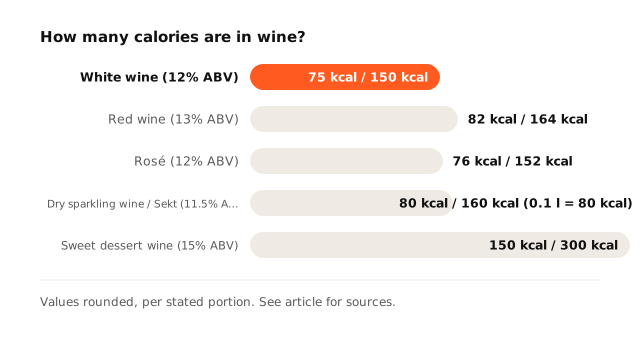
| Type | Calories per 100 ml / per 0.2 l glass |
|---|---|
| White wine (12% ABV) | 75 kcal / 150 kcal |
| Red wine (13% ABV) | 82 kcal / 164 kcal |
| Rosé (12% ABV) | 76 kcal / 152 kcal |
| Dry sparkling wine / Sekt (11.5% ABV) | 80 kcal / 160 kcal (0.1 l = 80 kcal) |
| Sweet dessert wine (15% ABV) | 150 kcal / 300 kcal |
Why wine calories get underestimated
Unlike food, alcohol gets burned by the body with priority — fat oxidation drops markedly while alcohol is being metabolized, as Suter et al. (1992) documented. So alcohol calories are not merely added on top; they also crowd out fat burning. In a calorie deficit, regular wine consumption can noticeably slow the pace of weight loss.
Sugar in wine
Wine is classified into residual-sugar categories: dry (under 9 g/l), off-dry (up to 18 g/l), semi-sweet (up to 45 g/l), and sweet (over 45 g/l). A dry red delivers under 2 g of sugar per 0.2 l glass, a semi-sweet white up to 9 g. Sweet wines like port or Sauternes contain considerably more, reaching up to 40 grams of sugar per glass.
Wine vs. beer
A 0.2 l glass of white wine (150 kcal) is roughly the energy equivalent of a 0.33 l (11 fl oz) beer (140 kcal). Per volume consumed, though, wine is the more calorie-dense drink — 75 kcal/100 ml versus around 43 kcal/100 ml for pilsner. The same rule applies to wine as to beer: the alcohol content is the biggest calorie driver.
Start tracking calories with GymLog AI
GymLog AI recognizes wine types with different alcohol and sugar contents and automatically calculates with standardized glass sizes.
Download on the App StoreSources
- Max Rubner Institute. Bundeslebensmittelschlüssel (BLS) — Germany’s national food composition database. blsdb.de
- USDA FoodData Central. Alcoholic beverage, wine, table, red / white. fdc.nal.usda.gov
- Suter, P. M., et al. (1992). The effect of ethanol on fat storage in healthy subjects. NEJM. PubMed
- German Federal Institute for Risk Assessment (BfR). Alcoholic beverages and health. bfr.bund.de