How many calories are in yogurt?

According to the German BLS food database, plain yogurt at 1.5% fat delivers around 47 kcal per 100 g (3.5 oz). Greek yogurt (10% fat) comes to 130 kcal/100 g, skyr to 63 kcal/100 g, and fruit yogurt to 85 to 110 kcal/100 g depending on sugar content.
Yogurt varieties in detail
Yogurt is made by bacterial lactic-acid fermentation of milk. Fat content, protein share, and added sugar determine the calorie count. The BLS (Germany’s national food composition database) lists standard products by fat grade; premium products such as Greek yogurt or skyr differ in how they’re processed.
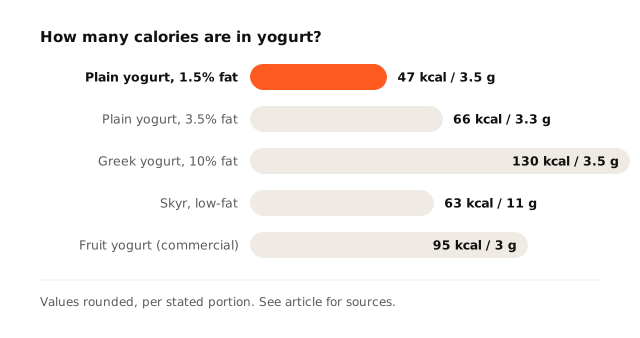
| Variety | Calories / protein per 100 g |
|---|---|
| Plain yogurt, 1.5% fat | 47 kcal / 3.5 g |
| Plain yogurt, 3.5% fat | 66 kcal / 3.3 g |
| Greek yogurt, 10% fat | 130 kcal / 3.5 g |
| Skyr, low-fat | 63 kcal / 11 g |
| Fruit yogurt (commercial) | 95 kcal / 3 g |
Skyr: the highest-protein alternative
Skyr originated in Iceland and is made by concentrating the protein more aggressively. At 11 g of protein per 100 g, it delivers roughly three times the protein of regular yogurt at a similar calorie count. In a calorie deficit or on a high-protein diet, skyr is one of the most efficient options going.
Fruit yogurt: a sugar trap
According to analysis by the German Nutrition Society (DGE), commercial fruit yogurt averages 12 to 15 g of sugar per 100 g — about half of it added sugar. A 150 g (5.3 oz) cup can thus pack up to 22 g of sugar, nearly 40 percent of the WHO recommendation for daily free-sugar intake (50 g for an adult on 2,000 kcal a day).
Probiotic effects
Per EFSA guidance, yogurt with live cultures can ease lactose digestion in people with lactose intolerance. Health claims beyond that (immune system, gut flora) are not sufficiently substantiated according to the EFSA. Germany’s Federal Institute for Risk Assessment (BfR) likewise remains cautious in its assessment of probiotic foods.
Start tracking calories with GymLog AI
GymLog AI automatically distinguishes yogurt varieties and logs skyr, fruit yogurt, and Greek yogurt with the correct values.
Download on the App StoreSources
- Max Rubner Institute. Bundeslebensmittelschlüssel (BLS) — Germany’s national food composition database. blsdb.de
- German Nutrition Society (DGE). Sugar reduction in foods. dge.de
- EFSA. Scientific Opinion on live yoghurt cultures and improved lactose digestion. efsa.europa.eu
- WHO. Guideline: Sugars intake for adults and children. who.int