Is sugar really bad for you?
Free sugars deliver mostly energy and few other nutrients. For an everyday diet, the common advice is to keep free sugars limited. The WHO's guideline is under 10 percent of total energy, ideally under 5 percent.
What “sugar” actually means
The word “sugar” covers several types of carbohydrate: simple sugars (glucose, fructose), disaccharides (sucrose — table sugar — and lactose), and more complex oligosaccharides. In a public health context, “sugar” usually means “free sugars”: sugar added to foods, plus the naturally occurring sugars in honey, syrups, and fruit juices. The sugar in whole fruit does not count as free (WHO, 2015).
The official guidance
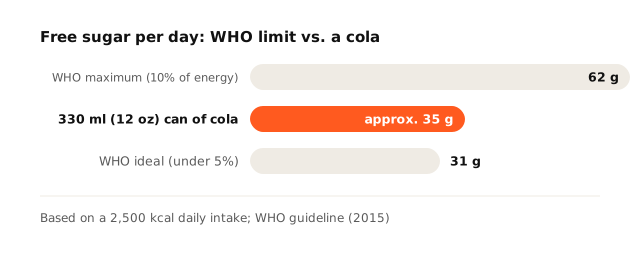
The WHO (2015) recommends limiting free sugar intake to a maximum of 10 percent of total daily energy — ideally under 5 percent. For an adult eating 2,500 kcal per day, that works out to 62 grams (10%) or 31 grams (5%). The German Nutrition Society (DGE, 2019) has adopted this recommendation.
Metabolic effects
According to Te Morenga et al. (2013), a high intake of free sugars is associated with higher energy intake and, as a result, weight gain. With an isocaloric exchange (same total energy), however, this effect disappears — the real problem is energy density, not some unique metabolic toxicity.
Tooth decay
The best-documented harm of free sugars is the risk of tooth decay (Moynihan & Kelly, 2014). Frequent contact with sugary drinks and foods drives acid production in the mouth, which demineralizes tooth enamel.
Sugar and strength training
In the context of strength training, sugar has no direct negative effects as long as it fits your overall calorie and protein budget. Kerksick et al. (2018) point out that fast-acting carbohydrates after training actually speed up glycogen resynthesis.
| Product | Free sugar (per serving) |
|---|---|
| 330 ml (12 oz) can of cola | approx. 35 g |
| 100 g granola bar | approx. 20–35 g |
| 200 g sweetened yogurt | approx. 15–20 g |
Start tracking your calories with GymLog AI
GymLog AI automatically detects free sugars and shows their share of your daily energy.
Download on the App StoreSources
- World Health Organization (2015). Guideline: Sugars intake for adults and children. who.int
- Te Morenga, L., et al. (2013). Dietary sugars and body weight: systematic review and meta-analyses of randomised controlled trials and cohort studies. BMJ, 346. PubMed
- Moynihan, P. J., & Kelly, S. A. M. (2014). Effect on caries of restricting sugars intake: systematic review to inform WHO guidelines. J Dent Res, 93(1). PubMed
- Stanhope, K. L. (2016). Sugar consumption, metabolic disease and obesity: The state of the controversy. Crit Rev Clin Lab Sci, 53(1). PubMed
- German Nutrition Society (DGE) (2019). DGE, DAG and DDG: Quantitative recommendation on sugar intake. dge.de