Dumbbell vs. barbell bench press — which is better?
Both variations produce comparable hypertrophy in the chest. Dumbbells allow a greater range of motion and more chest activation; barbells allow heavier maximal loads and better stability. Combining both variations is optimal.
Differences in the movement pattern
In the barbell bench press, both hands guide a single bar — the movement path is linear, and the bottom position is limited by the bar touching your chest. In the dumbbell bench press, each arm moves independently. The dumbbells can travel below chest level, which extends the range of motion and puts a deeper stretch on the pectoralis major.
Evidence on muscle activation
| Variation | Chest EMG activity |
|---|---|
| Barbell bench press | Moderate |
| Dumbbell bench press | Higher |
| Barbell (triceps activity) | Higher |
What the studies show
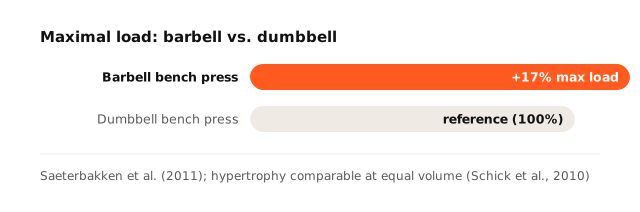
Saeterbakken et al. (2011) compared EMG activity at the same relative load between the barbell and dumbbell bench press in the Journal of Strength and Conditioning Research (JSCR). The dumbbell variation showed significantly higher activation of the pectoralis major, while the barbell bench press produced more triceps activity and allowed roughly 17 percent heavier maximal loads. Welsch et al. (2005) confirmed the higher chest activation with dumbbell variations.
Hypertrophy over the long term
An 8-week study by Schick et al. (2010) found no significant differences in chest growth between barbell and dumbbell bench pressing in trained men when training volume was matched. The extra activation from the dumbbell press was offset by the heavier absolute loads of the barbell press. For hypertrophy, both variations are equally effective — as long as the training volume is there.
Practical recommendation
The NSCA recommends combining both variations in your training:
- Barbell bench press as the main exercise for maximal strength and progression with heavier loads
- Dumbbell bench press as a follow-up exercise for full range of motion and muscular balance
- Incline dumbbell press to emphasize the upper chest with a deeper stretch
- Beginners benefit from starting with the more stable barbell setup to build technique
Log your workouts in 5 seconds with GymLog AI
GymLog AI automatically tells barbell and dumbbell variations apart and shows your volume separately for each movement pattern.
Download on the App StoreSources
- Saeterbakken, A. H., et al. (2011). A comparison of muscle activity and 1-RM strength of three chest-press exercises with different stability requirements. J Sports Sci. PubMed
- Welsch, E. A., et al. (2005). Electromyographic activity of the pectoralis major and anterior deltoid muscles during three upper-body lifts. JSCR. PubMed
- Schick, E. E., et al. (2010). A comparison of muscle activation between a Smith machine and free weight bench press. JSCR. PubMed
- NSCA. Essentials of Strength Training and Conditioning. nsca.com