How many steps per day to lose weight?

A daily step count of 8,000 to 10,000 raises your total energy expenditure by several hundred calories.
Where the 10,000-step rule comes from
The 10,000-step target traces back to a 1960s Japanese marketing campaign for a pedometer (Manpo-kei, literally "10,000-step meter") — it was never scientifically derived. What the actual research shows: the benefit of extra steps follows a dose-response pattern with diminishing returns.
The current evidence
Paluch et al. (2022) ran a meta-analysis on data from more than 47,000 adults examining the link between daily step count and all-cause mortality. The result: mortality risk drops markedly as step count rises, up to roughly 8,000 to 10,000 steps per day — beyond that, the curve flattens out.
How many calories steps actually burn
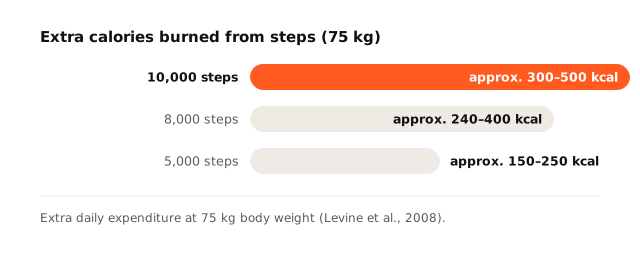
A person weighing 75 kg (165 lb) burns roughly 30 to 50 calories per 1,000 steps, depending on walking pace and terrain (Levine et al., 2008). Going from 3,000 to 10,000 steps per day therefore adds around 200 to 350 calories of daily energy expenditure — a substantial contribution to your calorie deficit during a diet phase.
Steps as a NEAT booster
Levine et al. (1999) showed that NEAT (non-exercise activity thermogenesis — all the movement you do without thinking about it) is one of the most variable components of energy expenditure. Deliberately boosting your step count by walking to work, taking the stairs, or going for a lunchtime walk is an effective lever for total expenditure — especially if you spend most of the day sitting.
| Step count | Extra calories (75 kg / 165 lb) |
|---|---|
| 5,000 | approx. 150–250 kcal |
| 8,000 | approx. 240–400 kcal |
| 10,000 | approx. 300–500 kcal |
Plan your deficit with GymLog AI
GymLog AI keeps your calorie and macro targets in one place and gives you a clear view of your progress.
Download on the App StoreSources
- Paluch, A. E., et al. (2022). Daily steps and all-cause mortality: a meta-analysis of 15 international cohorts. Lancet Public Health, 7(3). PubMed
- Levine, J. A., et al. (2008). The role of free-living daily walking in human weight gain and obesity. Diabetes, 57(3). PubMed
- Levine, J. A., et al. (1999). Role of nonexercise activity thermogenesis in resistance to fat gain in humans. Science, 283(5399). PubMed