How should you breathe during strength training?
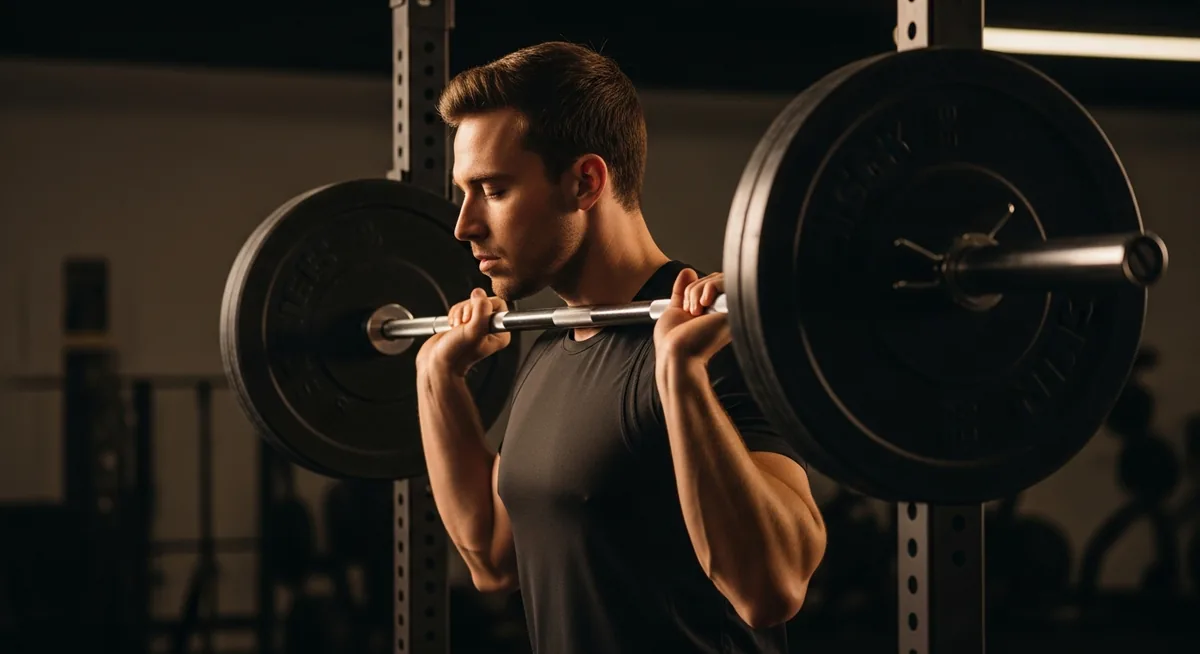
The standard technique: exhale during the concentric phase, inhale during the eccentric. Under heavy loads, the Valsalva maneuver (breath-holding and bracing) raises intra-abdominal pressure and stabilizes the spine.
The standard technique
The common recommendation follows the movement itself: inhale during the eccentric phase (lowering the weight) and exhale during the concentric phase (pressing the weight up). This breathing pattern works well for moderate loads and isolation exercises like biceps curls or lateral raises.
The Valsalva maneuver under heavy loads
At high loads (from roughly 80 percent of maximal strength upward), experienced lifters typically switch to the Valsalva maneuver: inhale before the movement, hold the breath, and brace against the closed glottis during the concentric phase. Hackett & Chow (2013) describe the mechanism: the air trapped in the chest and the braced abdomen raise intra-abdominal pressure, which passively stabilizes the spine and can boost strength output by 5 to 15 percent.
Risks of the Valsalva maneuver
Holding your breath causes a brief spike in blood pressure, which can be problematic with pre-existing cardiovascular conditions (high blood pressure, coronary artery disease). For healthy adults, a controlled Valsalva maneuver held for a few seconds during heavy single reps is considered safe according to Niewiadomski et al. (2012). Keep the duration short, though — ideally only through the hardest part of a rep.
Recommendations by exercise and load
| Situation | Breathing technique |
|---|---|
| Isolation exercise, moderate weight | In/out matched to the movement phase |
| Compound lift, 6–10 reps, medium load | Inhale before the set, brief brace, exhale at the top |
| Compound lift, 1–5 reps, heavy | Full Valsalva maneuver |
Common mistakes
The most common mistake is uncontrolled breathing under load — too shallow, restricted, or erratic. That raises injury risk through an unstable core. In his work on spinal biomechanics, Stuart McGill (2015) recommends deliberately coupling your breathing to the movement pattern and always starting compound lifts with a full chest of air.
Log your workouts in 5 seconds with GymLog AI
GymLog AI records load and rep counts so you can match your breathing technique to the right intensity range.
Download on the App StoreSources
- Hackett, D. A., & Chow, C.-M. (2013). The Valsalva maneuver: its effect on intra-abdominal pressure and safety issues during resistance exercise. J Strength Cond Res, 27(8). PubMed
- Niewiadomski, W., et al. (2012). Determination and prediction of one repetition maximum (1RM): safety considerations. J Hum Kinet, 33. PubMed
- McGill, S. M. (2015). Low Back Disorders: Evidence-Based Prevention and Rehabilitation. Human Kinetics (3rd ed.).