When should you eat for muscle growth?

For muscle growth, evenly spacing protein-rich meals across the day is often discussed. As a rule, though, total daily intake matters more than precise timing.
Total intake vs. timing
The fitness industry tends to overrate meal timing. In a meta-analysis, Schoenfeld, Aragon and Krieger (2013) examined the effect of protein timing on strength and hypertrophy. Once total protein intake was controlled for, the significant timing effect disappeared. The authors concluded that total daily protein is the dominant factor — not when you take it.
Spreading protein across the day
In a controlled study, Areta et al. (2013) showed that distributing protein evenly across 4 meals of 20 g each stimulated muscle protein synthesis over 12 hours more strongly than 2 large meals of 40 g or 8 small ones of 10 g. In its position stand, the ISSN (Jäger et al., 2017) recommends a protein intake of 0.4 to 0.55 g/kg per meal, spread across 3 to 4 meals.
| Strategy | MPS stimulation (12 h) |
|---|---|
| 4 × 20 g protein | highest |
| 2 × 40 g protein | moderate |
| 8 × 10 g protein | lowest |
Peri-workout nutrition
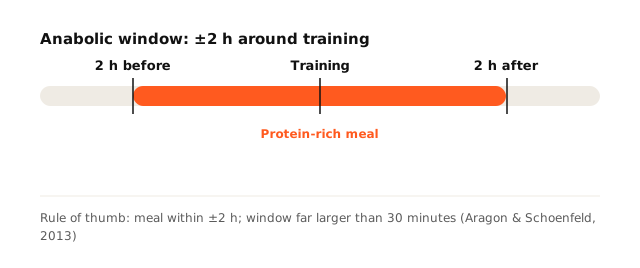
How much the meal around your workout matters depends on how long ago you last ate. Aragon and Schoenfeld (2013) put it this way: if you had a protein-rich meal 3 to 4 hours before training, you don't need to take in protein immediately afterwards — amino acid levels are still sufficiently elevated. After training fasted, eating soon after the session is the common practical choice. A useful rule of thumb: a protein-rich meal within 2 hours before and after training.
Keep your protein in view with GymLog AI
GymLog AI shows you whether your protein is spread evenly across the day — automatically with every entry.
Download on the App StoreSources
- Schoenfeld, B. J., Aragon, A. A. & Krieger, J. W. (2013). The Effect of Protein Timing on Muscle Strength and Hypertrophy: A Meta-Analysis. Journal of the International Society of Sports Nutrition, 10(1), 53. PubMed
- Areta, J. L., et al. (2013). Timing and Distribution of Protein Ingestion During Prolonged Recovery From Resistance Exercise Alters Myofibrillar Protein Synthesis. The Journal of Physiology, 591(9), 2319–2331. PubMed
- Jäger, R., et al. (2017). International Society of Sports Nutrition Position Stand: Protein and Exercise. Journal of the International Society of Sports Nutrition, 14, 20. PubMed
- Aragon, A. A. & Schoenfeld, B. J. (2013). Nutrient Timing Revisited: Is There a Post-Exercise Anabolic Window? Journal of the International Society of Sports Nutrition, 10(1), 5. PubMed