Rest-pause training: what does it actually do?

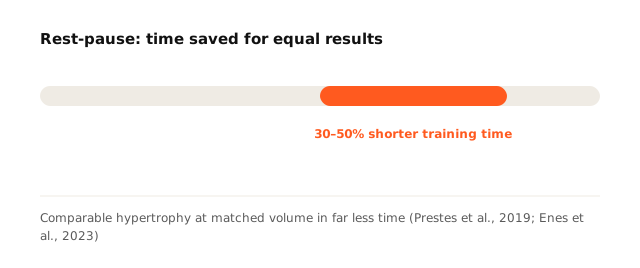
At matched volume, rest-pause sets produce hypertrophy comparable to straight sets — in just 30 to 50 percent of the training time. They're primarily interesting as a time-efficient intensity technique, not as the foundation of your training.
What is rest-pause?
A rest-pause set consists of a working phase taken close to muscle failure, a short break of 15 to 30 seconds, and one or more additional mini working phases with the same weight. A typical scheme is 8–4–2–1: one full stretch of reps followed by several short bursts with decreasing rep counts and fixed pauses. Unlike a drop set, the weight stays the same — only the recovery time between the mini-sets is cut down.
Effects at a glance
| Parameter | Rest-pause vs. traditional |
|---|---|
| Hypertrophy at matched volume | Equal |
| Time required per set block | 30–50% shorter |
| Maximal strength transfer | Equal to slightly lower |
What the evidence shows
A study by Prestes et al. (2019) compared rest-pause training head to head with traditional strength training over 6 weeks. With work matched, both groups showed comparable gains in muscle cross-sectional area and strength — but the rest-pause group needed considerably less time to get there. A further study by Marshall et al. (2012) found no advantages for rest-pause at matched rep counts, but no drawbacks either.
Using it sensibly in your program
In its position stand on training efficiency, the ISSN recommends rest-pause sets as an optional variation for people with limited training time. In practice, the technique works particularly well for:
- Isolation exercises like biceps curls, triceps extensions, or lateral raises
- Machine-based compound exercises (leg press, chest press)
- The final one or two sets of an exercise — not every set
On free-weight compound lifts like the squat or deadlift, Schoenfeld (2020) advises against rest-pause for safety reasons, since technique deteriorates under fatigue.
Beginners or advanced lifters?
For beginners, rest-pause isn't the go-to choice. In the first year or two of training, technical execution and progressive overload matter more than sophisticated intensity techniques. Advanced lifters can use rest-pause strategically to break through plateaus or compress workouts when time is short.
Log your workouts in 5 seconds with GymLog AI
GymLog AI tracks rest-pause sets and intensity techniques automatically — including rest times and volume per muscle group.
Download on the App StoreSources
- Prestes, J., et al. (2019). Comparison Between Traditional Resistance Training and Rest-Pause Method on Strength and Body Composition. JSCR. PubMed
- Marshall, P. W., et al. (2012). Rest-pause versus traditional resistance training in trained men. JSCR. PubMed
- Enes, A., et al. (2023). Rest-Pause vs. Traditional Resistance Training on Hypertrophy. Sports Medicine. PubMed
- Schoenfeld, B. J. (2020). Science and Development of Muscle Hypertrophy. Human Kinetics. Publisher