Tempo and time under tension — what do they really do?

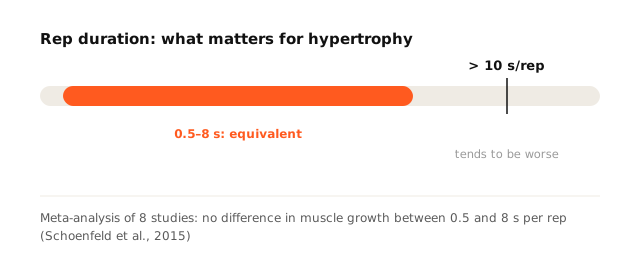
For hypertrophy, rep durations anywhere between 0.5 and 8 seconds per rep are equivalent according to meta-analysis, as long as the set ends close to muscular failure. Extremely slow training without matching volume offers no extra benefit.
What time under tension means
Time under tension (TUT) describes the total time a muscle spends under load per set. It's usually measured in seconds and breaks down into the concentric phase (lifting), the isometric phase (holding), and the eccentric phase (lowering). A typical tempo prescription is written as 4-1-2-0 — four seconds eccentric, a one-second pause at the bottom, two seconds concentric, no pause at the top.
The evidence at a glance
| Rep tempo | Effect on hypertrophy |
|---|---|
| Fast (≤ 2 s/rep) | Equivalent |
| Moderate (2–4 s/rep) | Equivalent |
| Slow (4–8 s/rep) | Equivalent |
| Very slow (> 10 s/rep) | Tends to be worse |
What the research shows
A meta-analysis by Schoenfeld et al. (2015) evaluated 8 controlled studies on how rep tempo affects hypertrophy. The verdict: within a range of 0.5 to 8 seconds per rep, there were no significant differences in muscle growth. What matters is finishing the set with high effort, close to muscular failure — not the exact tempo.
The eccentric phase deserves special attention
The eccentric phase (lowering the weight) is especially demanding on the muscle. Studies by Roig et al. (2009) in the BJSM showed that eccentric-emphasized training offers slight advantages for muscle cross-sectional area and strength. In practice, that means: lowering the weight under control over 2 to 4 seconds instead of letting it drop makes your training more effective — without artificially slowing down the concentric phase.
Practical recommendation
For hypertrophy, the NSCA and ISSN recommend a tempo with a two- to four-second eccentric phase and an explosive but controlled concentric phase. Deliberately slowing down the concentric phase offers no extra benefit according to the evidence — but it does reduce the weight you can use, and with it the mechanical tension that is the most important driver of hypertrophy.
Log your workouts in 5 seconds with GymLog AI
GymLog AI tracks sets, rest periods, and optionally tempo — so you can use time under tension wisely without wasting time.
Download on the App StoreSources
- Schoenfeld, B. J., et al. (2015). Effect of Repetition Duration During Resistance Training on Muscle Hypertrophy: A Systematic Review and Meta-Analysis. Sports Medicine. PubMed
- Pereira, P. E. A., et al. (2016). Resistance training with slow speed of movement is better for hypertrophy and muscle strength gains? J Sports Med Phys Fitness. PubMed
- Roig, M., et al. (2009). The effects of eccentric versus concentric resistance training on muscle strength and mass in healthy adults: a systematic review with meta-analysis. BJSM. PubMed
- NSCA. Essentials of Strength Training and Conditioning. nsca.com