Vitamin D: how much per day?

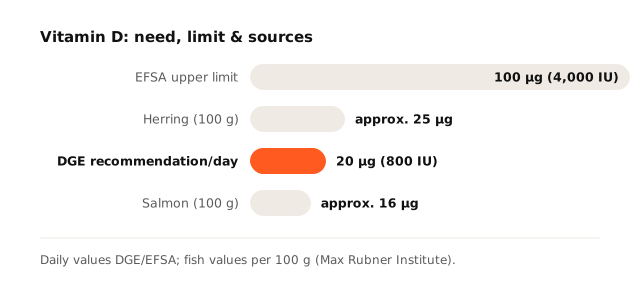
When the body can't make its own, the German Nutrition Society (DGE) recommends a daily intake of 20 µg (800 IU) of vitamin D. The EFSA sets the safe upper limit at 100 µg (4,000 IU) per day.
What is vitamin D?
Vitamin D is a fat-soluble prohormone that the body can produce in the skin given enough UVB radiation. From October to March, however, sunlight in Central Europe is too weak for adequate self-synthesis. Diet alone (oily fish, egg yolk, mushrooms) also makes it hard to cover the requirement.
Supply status in Germany
The National Nutrition Survey II by the Max Rubner Institute (2008) found that around 82% of men and 91% of women in Germany don't reach the German Nutrition Society (DGE) reference value of 20 µg (800 IU) of vitamin D per day through diet alone. Based on the DEGS1 study, the Robert Koch Institute (RKI, 2016) reports that around 30% of adults in Germany have a vitamin D deficiency (serum level < 30 nmol/l), with a seasonal rise in winter.
Official intake recommendations and safety
When endogenous synthesis is lacking, the DGE recommends a daily intake of 20 µg (800 IU) of vitamin D. Germany's Federal Institute for Risk Assessment (BfR, 2021) classifies daily supplementation of up to 20 µg (800 IU) as safe. The European Food Safety Authority (EFSA, 2012) sets the tolerable upper limit at 100 µg (4,000 IU) per day for adults.
Food sources
The richest dietary vitamin D sources are oily sea fish (herring: approx. 25 µg/100 g, salmon: approx. 16 µg/100 g), egg yolk (approx. 2–3 µg per egg), and foods fortified with vitamin D. Because dietary intake often isn't enough in Central Europe, supplementation — especially during the winter months — is a common option.
Vitamin D and muscle function
In a systematic review and meta-analysis, Beaudart et al. (2014) evaluated 30 randomized controlled trials on the effect of vitamin D supplementation on skeletal muscle. They observed a small positive overall effect on global muscle strength, which was most pronounced in people with a baseline 25-hydroxyvitamin D level below 30 nmol/l. In this analysis, supplementation showed no significant effect on muscle mass or muscle power.
Track your supplements with GymLog AI
GymLog AI logs your nutrition and shows your trends over time at a glance.
Download on the App StoreSources
- German Nutrition Society (DGE) (2012). Vitamin D — Reference Values for Nutrient Intake. DGE
- Robert Koch Institute (2016). Vitamin D status in Germany — DEGS1. Journal of Health Monitoring, 1(2). RKI
- EFSA (2012). Scientific Opinion on the Tolerable Upper Intake Level of Vitamin D. EFSA Journal, 10(7), 2813. EFSA
- Max Rubner Institute (2008). National Nutrition Survey II — Results Report Part 2. BMEL
- Beaudart, C., et al. (2014). The Effects of Vitamin D on Skeletal Muscle Strength, Muscle Mass, and Muscle Power: A Systematic Review and Meta-Analysis of Randomized Controlled Trials. Journal of Clinical Endocrinology & Metabolism, 99(11). PubMed