Bodyweight training without equipment: can you build muscle?
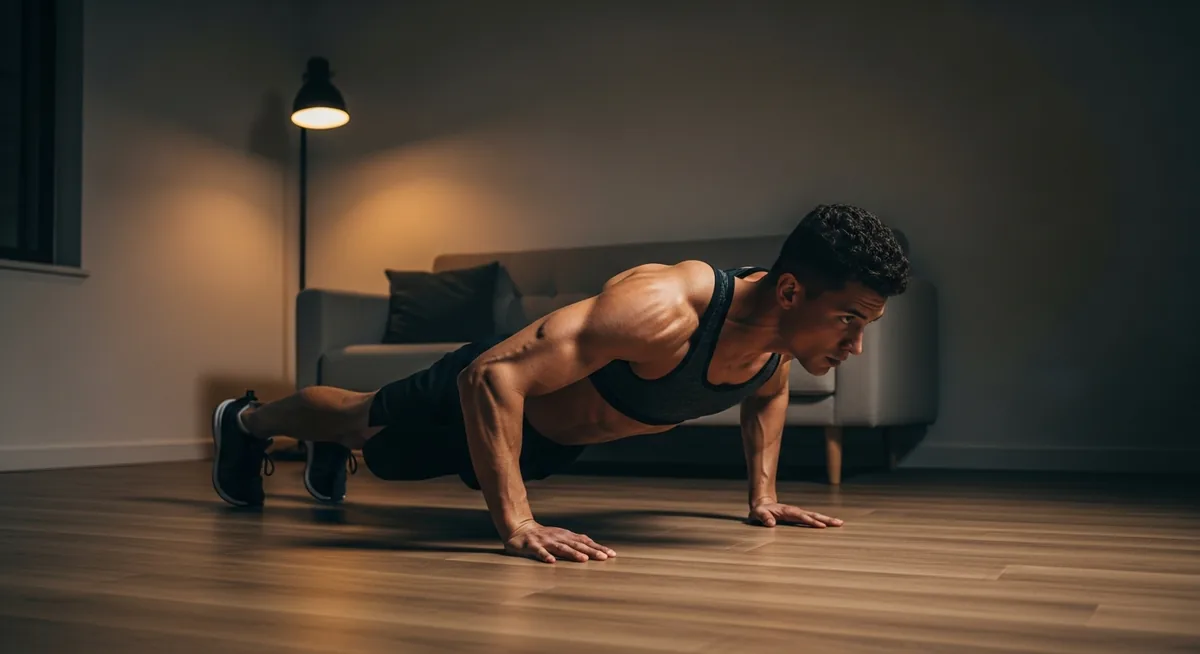
Building muscle with nothing but your own body weight works for beginners and intermediates up to a plateau. The keys are progressive overload through harder exercise variations and sufficient volume. For maximal strength and continued hypertrophy, weights remain superior.
The evidence on building muscle without equipment
Calatayud et al. (2015), writing in the Journal of Strength and Conditioning Research (JSCR), compared the bench press with push-ups. At the same subjective level of effort (RPE), both exercises produced comparable muscle activity in the chest. Kikuchi and Nakazato (2017) showed over 8 weeks that push-ups delivered hypertrophy gains in trained men similar to bench pressing at 40 percent of 1RM — as long as sets were taken to muscle failure.
Bodyweight vs. weights at a glance
| Goal | How well bodyweight works |
|---|---|
| Hypertrophy (beginners) | Very well |
| Hypertrophy (intermediate/advanced) | Well, up to a plateau |
| Maximal strength | Limited |
| Leg development (bodyweight only) | Difficult |
How progressive overload works without weights
Muscle growth requires a steadily increasing training stimulus. In bodyweight training, you can engineer that with mechanical tricks: lengthening the levers (feet elevated for push-ups), progressing to single-arm variations, slowing down the eccentric, pausing in the stretched position, or adding reps per set. According to Schoenfeld et al. (2014), high-rep training with light loads is just as effective for hypertrophy as moderate loads — provided you reach muscle failure.
An effective bodyweight program
For building muscle without equipment, the NSCA recommends this basic structure:
- Push movement: Push-ups (variations: decline, diamond, one-arm) — 3 to 4 sets
- Pull movement: Pull-ups on a doorway bar or tree branch — 3 to 4 sets
- Leg movement: Bulgarian split squats, pistol squats, step-ups — 3 to 4 sets
- Core: Planks, side planks, hanging leg raises — 2 to 3 sets
- Frequency: 3 to 4 sessions per week, taking sets close to muscle failure
The limits of bodyweight training
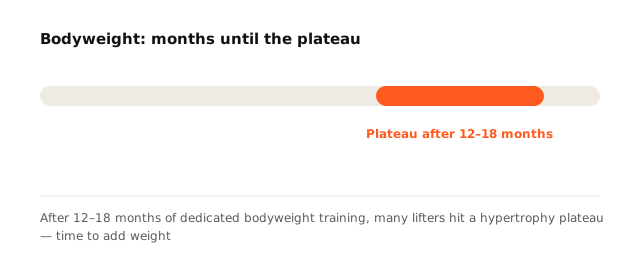
After 12 to 18 months of dedicated bodyweight training, many lifters hit a hypertrophy plateau. You can keep making the exercises harder, but at some point the neuromuscular demand outgrows the purely muscular one — one-arm push-ups are primarily a stabilization challenge, not a recipe for additional muscle mass. At that point, switching to free weights or machines becomes necessary for further growth.
Log your workouts in 5 seconds with GymLog AI
GymLog AI tracks bodyweight exercises with reps, hold times, and difficulty levels — so progressive overload stays measurable even without weights.
Download on the App StoreSources
- Calatayud, J., et al. (2015). Bench press and push-up at comparable levels of muscle activity result in similar strength gains. JSCR. PubMed
- Kikuchi, N., Nakazato, K. (2017). Low-load bench press and push-up induce similar muscle hypertrophy and strength gain. J Exerc Sci Fit. PubMed
- Schoenfeld, B. J., et al. (2014). Effects of low- vs. high-load resistance training on muscle strength and hypertrophy in well-trained men. JSCR. PubMed
- NSCA. Essentials of Strength Training and Conditioning. nsca.com